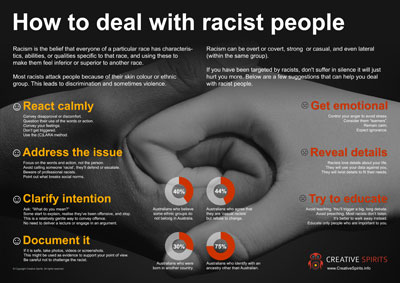
Click the image to download this infographic (A4 printable).
When you are the victim of, or witness racist behaviour, have you felt frozen and mute, unable to address the racist? Or violently angry?
These are very common reactions. Many people feel very uncomfortable to interject, or even talk about, racism. But many also would like to do the right thing.
Many wrongs in history were rightened when people overcame their discomfort and spoke up: voting rights, marriage equality, citizenship, human rights. Comfort and silence would not have been successful. [1]
Here's a list of suggestions and techniques that might help you get a little more comfortable with speaking up, compiled from various people's responses to the question "How do you deal with racist people?"
Everyday racism has to be tackled by ordinary people.
Convey disapproval or discomfort, without provoking a defensive reaction.
Question their use of the words or action so you can gauge their intent: "Why do you say/do that?"
Convey your feelings: Let them know how the comment or joke makes you feel.
Question their fear. These can be very useful moments to question someone's fear and ignorance.
Don't get triggered. Racists want to push your button to get you angry. Just laugh and keep walking.
Compliment them on something: 'Nice shirt', 'Nice beard' or just 'Love you, mate'.
Research found that speaking up is good for the bystander (lasting satisfaction of having done something), good for the victim of the racist attack (feel a sense of belonging and less damaged by the abuse) and possibly good for the offender (bystander action disproves that their prejudice is the norm and may make them less ready to express it). [2]
"People who are racist think they have go more support in society than they do. If you don't say anything they'll continue to think that. If you do, they start to reassess," says Prof Yin Paradies from Deakin University, who helped create Everyday Racism, a free mobile phone app that allows you to slip into the shoes of, among other roles, an Aboriginal man.
One person challenging a racist comment in a calm and measured way in a train, a bus, at a party, at work can have a profound influence on all those who witness it.
Resource: The book How to Argue With a Racist by Adam Rutherford discusses the history and science (yes, there's such a thing!) of racism. It gives practical tips to combat "well-intentioned" and "pseudo-science" racism (e.g. black people are born athletes).
"A weapon against scientific racism." – "A fascinating and timely refutation of the casual racism on the rise around the world."
Be kind
Sometimes people make a racist remark because they don't think or just thoughtlessly copy what they heard before. Being kind to them might just wake them up.
Story:
The tea pot treatment
Perth man Jarred Wall was having lunch with a friend in Fremantle when he heard two elderly ladies talking about Aboriginal people.
"The conversation was less than distasteful with words like assimilation being thrown around willy nilly," he wrote in a Facebook post. "I could have unleashed a tirade of abuse but that wouldn’t have helped.”
Instead, he decided to buy them a pot of tea — leaving a handwritten note on the receipt that said: “Enjoy the tea! Compliments of the two Aboriginals sitting next to you on table 26.”
"Maybe these ladies will be a little wiser and think before they speak," he wrote in the post. "Hopefully there won’t be a next time!”
React towards the issue, not the person
Proverb: Buddha says when someone fires an arrow into you, you don't try and find out who fired the arrow and what they are all about. You concentrate on getting the arrow out.
Avoid calling someone a 'racist'. People get more upset about being called racist than the fact that their actions were racist. In a comment someone said "You sound racist." That is a better alternative as it is targeted towards the choice of words and not the person.
Beware of professional racists. "Undercover racists" spend their whole lives trying to be undercover. They have perfected the act of flipping the script no matter what you say about them.
Point out what breaks social norms. Tell them that their message or action was racist. Doing this conveys social norms (i.e. what is considered to be acceptable).
Reply with a very short email to the effect of: "I received [the thing] you forwarded to me. I think it is racist and was very offended by it. Please do not forward anything like that to me in the future." Sign off as you usually do with that person (no emotions).
Example responses to a racist ethnicity comment
Tell them that you distant yourself and your family from them because you don't agree with their beliefs. Wish them the best in life and tell them that when they change their tune, they can apologise and re-enter your life.
Tell them that God loves every colour, that's why he created so many of them.
Example response to a racist joke
"Would you want your daughter or son to hear that joke come out of your mouth?"
Story:
"Get your insults straight!"
Comedian Margaret Cho recounted how one time someone called her a "chink" [English ethnic slur referring mainly to a person of Chinese ethnicity].
She looked the guy straight in the eye and said, "I'm Korean, I'm not a chink, I'm a gook. If you're going to be racist, get your insults straight!"
Respond with the opposite
Writer Jane Caro offers another strategy: [3] Respond with the exact opposite of the emotion they are trying to provoke. That is, if they are trying to make you angry, stay calm. If they are trying to shame you, be proud, including of what might be perceived as negative (e.g. being old). Be cheerful if they want to verbally hurt you.
Be the first to call the police
Western Australian Noongar man Simon Jagamara witnessed racists harassing Aboriginal people in Perth. His advice is to be the first to call the cops:
"Do not fall into [the racists'] traps of forcing retaliation. They will try everything to upset the Blackfella. You will be harassed, you will be attacked but do not retaliate. This happened to you last time, they started it, the passers-by and the racists but instead of retaliating you must do only one thing, pick up the phone and call the police. Because their law works this way, first in first served. If you complain first then they will be charged, if they complain first you will be charged." [4]
Document & threaten them
When a Twitter user racially abused Benjamin Law, an Australian journalist and author of Asian descent, he "quietly spend half an hour in silent rage", finding out his business name, street address and phone number, and taking screenshots of the troll's tweets.
Law then contacted him and threatened to send all that information to his local newspaper. The troll went quiet. [5]
Don't follow your initial emotional response
Control your anger. If you're getting worked up you only suffer high blood pressure and stress.
Consider them "learners". Remember that they might be less enlightened and tolerant than you are. They might not even know that their comment or action is racist.
Remain calm. Anger is a weapon only to one's opponent.
Expect ignorance. People's ability to convince themselves they are not racist is astounding ("I'm not racist, but…").
How one black pastor defeated the Ku Klux Klan
In this video former Ku Klux Klan leader Johnny Lee Clary remembers how he finally had to give up harassing a black pastor who used wit and humour to defeat him.
Don't reveal personal details
Racists love details about your life. When a friend of mine was racially challenged online he started to reveal personal details to prove his case. Don't do that. Racists will use your data against you and it might stay on that website for a long time.
Don't react at all
Don't waste your energy. People give racist comments for the sole reason of getting attention. Any response, even negative, gives them exactly what they want.
Focus on other things. By completely ignoring them they are less likely to continue.
Research shows the overwhelming majority of bystanders witnessing a racist incident will remain silent and do nothing, [2] mainly out of fear.
Don't try to educate
Avoid teaching. Don't get into a big debate or try to educate the person.
Avoid preaching. Unless you see some indication that the person was willing to listen and to dialogue don't try to change their beliefs.
If you are very comfortable in your skin and in a position to point out a racist act, you can try doing that.
Doing that, you might set a new norm. As writer Brandon Jack finds: "Why are the ones who call out racism, who call out sexism, who call for change seen as outspoken. Why is diplomacy – often some half-acknowledgement with shallow words that let existing standards prevail – the acceptable response?" [6]
Journalist Kate McClymont was on a job with her photographer when he was threatened by the 100-kilograms interviewee. When the man also verbally abused her, she published the threats in her story. [7]
The best way to deal with bullies is for everyone to see them as they are.
Story:
"I don't want to work with for a black guy"
Here's a story "Yetanotheruser" posted in a forum:
My wife is African-American, and I am Euro-American (white).
Shortly after we got married we moved to Florida, where I got a job on a construction crew. The contractor we were working for had several crews, and as we were finishing up one house, the discussion turned to where each individual was going next.
One guy, Chris, said, "I don't want to work on Joe's crew." Joe was a black man, and had a reputation for being a good foreman to work for. The conversation continued, and Chris was asked, "Why not?"
I listened as Chris replied, "Well, you know, he's black, and I don't want to work with for a black guy."
I continued to work alongside Chris, listening as the conversation continued. "What's wrong with working with a black guy?" someone else asked.
Chris then went on to the usual list of stereotypes, "Well, the stink, they're lazy…" and so on. At this point, I couldn't keep quiet.
"You know, Chris, one of them did something to me that is going to affect me for the rest of my life!"
Chris took the bait…"what was that?"
I replied, "She married me!"
Chris started back-pedalling like I had never seen! "Well, they're not all bad!" [8]
How to respond to social media comments
Many people comment on social media, and no matter what the intention – benign or malicious – comments can be ignorant at best or racist at worst.
Some social media users try to distract from racism by putting other, "more important" issues to the front: "But what about war? Hunger? The pandemic?" This is only a smokescreen to avoid the discussion about racism.
Response: This problem exists and affects people every day. It is up to them to decide if it is important. People who most likely never have such experiences should not make that decision.
"But there's also racism against whites!"
Others list examples of discrimination against 'white' people, e.g. if they have tattoos. A good example is the use by some of the "All Lives Matter" slogan to counter the "Black Lives Matter" call in 2020. It's another attempt to distract and block equality.
Response: Having tattoos is a personal decision that people can reverse anytime they want. But people who experience racism and discrimination because of their skin colour never had that choice, nor could they change it. This are two very different things.
"I don't see colour"
Some people comment that they're "colourblind" or "all people are equal". It sounds well-meaning at first sight, but it's not an attempt to listen or inquire about the issue. It reiterates an end goal we haven't achieved yet in society. Similarly, if some people decide an issue is not racist it is not – they make the decision. ("I don's see a slave, I see a beautiful woman.")
Response: While this comment might be well-meaning, reality is different. People of colour face hardship looking for jobs and accomodation, when shopping or eating out. They don't have the same opportunities. Thinking "all people are equal" ignores that reality, comes from a privileged point of view and is not helpful. We need to take their response seriously and accept what they decide.
"My friend is black and doesn't have a problem with it."
People who use this argument assume they can relax because their friend of colour absolved them from any wrong-doing. There is no racism – their friend has said so!
Response: There is great diversity within the community of black people. In Australia, some Aboriginal people are okay with being called "Indigenous", others find the word offensive. If your friend accepts it, other might disagree. It shouldn't be an excuse not to think critically about it.
"It's racist to change just because someone complained!"
If someone calls out a racist act, others might call them a racist. Such commentators try to swap victims with perpetrators: It's not racist to depict black people as savages, but to change offensive place names and thus remove the "visibility" of the issue. Racist is not who says the N-word but those who interpret it as racist.
Response: The definition of racism is clear: If a minority is treated differently, discriminated or disadvantaged because of perceived or real cultural or physical characteristics, then this is racism. Everything else is twisting the facts.
Video: How to tell people they sound racist
More resources
OpenColleges offers an article about how to handle bullying. They cover the types of bullying and discuss how to handle being bullied, with a focus on children and teachers.
Debra Leigh, Organiser of the Community Anti-Racism Education Initiative, has written an excellent essay listing 28 common racist attitudes and behaviours. The full list is available on Tumblr.
Join thousands of Smart Owls!
This website is using cookies
This site uses cookies to personalise your experience.
If you continue using the site, you indicate that you are happy to receive cookies from this website.