The Aboriginal flag and Torres Strait Islander flag are among Australia's official flags. But states and territories still hesitate to fly them next to the Australian national flag.
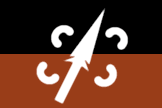
Aboriginal flag alternative. Black symbolises Aboriginal people, brown the land.
An early version of the Aboriginal flag was designed by the founders of the Aboriginal Tent Embassy[1] in April 1972.
It had a black top half, representing Aboriginal people, over a lower ochre-brown (some sources say red [2]) half, representing the land. A white spear joined both halves representing the movement of Aboriginal resistance and political struggles [1], the "warrior spirit" of Aboriginal people.
Meaning
The four white crescent shapes representing Aboriginal unity for land rights [3], the black rights struggle from the four corners of Australia [2], or Aboriginal people coming together in unified council [1].
In another interpretation this Aboriginal flag is thought to have been an entry in a national competition. The barbed spear (which was couped at the base) represented the European invasion of the Australian continent on 26 January 1788. The four surrounding crescent shapes represented "Aboriginal elders discussing the invasion" [4].
Present-day Aboriginal flag
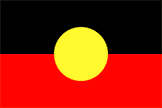
Present-day Aboriginal flag. Red symbolises the red earth, black the Aboriginal people and yellow the sun. Web colour codes: red = #c00, yellow = #ff0, black = #000.
Aboriginal Elder Harold Thomas, a Luritja man from Central Australia, designed the Aboriginal flag in 1971. It was created as a symbol of unity and national identity for Aboriginal people during the land rights movement of the early 1970s. The bright colours of the Aboriginal flag are no coincidence. Harold Thomas used them deliberately "to be eye-catching in land rights protests". [5]
Meaning
Yellow represents the sun (giver of life) and yellow ochre. Red represents the red earth (the relationship to the land) and the red ochre used in ceremonies. Black represents the Aboriginal people.
Red has sometimes been considered to represent the blood Aboriginal people shed during the wars with white settlers.
Thomas originally considered black to be at the bottom but then decided to revert the intuitive order: "I wanted to make it unsettling. In normal circumstances you'd have the darker colour at the bottom and the lighter colour on top ... To give a shock to the viewer to have it on top had a dual purpose, [one] was to unsettle ... The other factor why I had it on top was the Aboriginal people walk on top of the land." [6]
History
Aboriginal activist Gary Foley took the flag to the east coast of Australia where it was promoted and eventually recognised as the official flag of Australia's First Peoples. Cathy Freeman brought the flag to the international stage during her victory lap after winning the 200m at the 1994 Commonwealth Games (and again after winning the 400m at the 2000 Olympic Games in Sydney).
The Aboriginal flag was first displayed on 12 July 1971 on National Aborigines Day, at Victoria Square in Adelaide. It was also used at the Tent Embassy in Canberra in 1972.
In June 1995, the Australian Government proclaimed the Aboriginal flag as an official 'Flag of Australia' under section 5 of the Flags Act 1953. [7] Two years later Harold Thomas was recognised as the author of the artistic work under the Copyright Act 1968.
Due to administrative oversight the proclamation of 1995 was not lodged in accordance with the requirements to ensure it remained in force, and it expired on 1 January 2008. [8] As a result the Governor‑General proclaimed the Aboriginal Flag "as the flag of the Aboriginal peoples of Australia and a flag of significance to the Australian nation generally" for the second time on 25 January 2008. [9]
After the 30th anniversary of the Aboriginal flag, the council of the City of Adelaide recommended to permanently fly the Aboriginal flag in Victoria Square and at the front of the town hall. This marked the time many more cities began to also fly the Aboriginal flag next to the national flag on official buildings.
Many Australians are now reconsidering the national Australian flag and want to merge it with the Aboriginal flag, for example by replacing the Union Jack.
Copyright
In 1997 the Federal Court of Australia declared that Harold Thomas was the owner of copyright in the design of the Australian Aboriginal flag, and thus the flag has protection under Australian copyright law. If you intended to reproduce it you needed to obtain his permission first.
Since 1998, Victorian-based flag manufacturer, Carroll & Richardson Flagworld, held an exclusive licence to reproduce the Aboriginal flag. In November 2018, Thomas signed another exclusive licence for using the flag on clothing with another company, WAM Clothing. This company announced in 2019 that it was now the "exclusive worldwide licensee for the use of the Aboriginal flag on digital media and physical media" [10] and charged a licence fee from anyone who wanted to use the flag.
In 2022 the Australian government obtained the copyright to the flag and terminated commercial licenses owned by companies. Now anyone can use the flag freely without restrictions, while its commercial production remains with Carroll & Richardson Flagworld. [11] Since the Aboriginal flag is now managed like the Australian national flag, you must present in a respectful and dignified way. [12]
Upside down Aboriginal flag
If in doubt about how to fly the Aboriginal flag, remember "black people are walking on red earth". [13]
Occasionally you might see an Aboriginal flag flown upside down, i.e. with the red colour at the top and the black at the bottom.
In most cases this is a mistake and should be corrected as soon as possible to avoid causing offence and distress to Aboriginal people, and embarrassment to the person or organisation who raised the flag.
Sometimes the upside down flag is intentional. Flying a flag upside down is widely considered a signal of distress, or threat to life or property. During Aboriginal protests flag bearers might choose to display the Aboriginal flag that way.
However, Australian national flag protocols prescribe to "not fly the flag upside down, even as a signal of distress". [14]
Story:
How one athlete put the Aboriginal flag on the (world) map
In 1992 Aboriginal runner Cathy Freeman hung the Aboriginal flag in her room at the Barcelona Olympic Games, where she missed out on the final.
The flag was with her again during the 1994 Commonwealth Games in Victoria, Canada. After winning the 400m sprint she grabbed the Australian and Aboriginal flags for her victory lap.
“I took the flag and draped it over my shoulders like a cape and trotted off. I wanted to shout, ‘Look at me, look at my skin. I’m black and I’m the best!’ There was no more shame,” Cathy writes in her autobiography Cathy: Her Own Story.
It was an act of defiance. Games rules said that only one national flag could be shown. But she did it again after also winning the 200m sprint.
Until her triumphant laps in Canada, the flag had rarely been seen as a symbol of victory. Cathy changed its image forever. [15][16]
Why is the Aboriginal flag not flown on Sydney's Harbour Bridge?
Many (including me) are asking why the Aboriginal flag is not flown permanently on the Sydney Harbour Bridge while it flies permanently outside courthouses, at public schools and at Parliament House.
The Harbour Bridge shows the Aboriginal flag only 4 times a year:
Australia Day (January)
National Apology Day (February)
Reconciliation Week (May)
NAIDOC Week (July)
My inquiry was answered by the Roads and Traffic Authority (RTA) which owns the bridge. [17]
"The Australian Flag is permanently flown on the Sydney Harbour Bridge because… it is the one flag which is nationally and internationally recognised as the symbol of our identity as a nation."
"The NSW State Flag is flown in recognition that the Harbour Bridge is one of our most significant assets. On at least two weeks of the year, however, the NSW State Flag is exchanged for the Australian Aboriginal Flag in recognition of the significant contribution of our Aboriginal people. These occasions include Reconciliation Week… and NAIDOC (National Aborigines and Islanders Observance Committee) Week…"
So—the NSW State Flag celebrates the bridge for 50 weeks a year, while the Aboriginal flag celebrates Aboriginal culture for two weeks a year. Now you know where the state government's priorities are.
In 2018, NSW Premier Gladys Berejiklian confirmed twice this arrangement would remain unchanged. [18][19]
Should Australia adopt a new flag, free from the Union Jack?
A petition for the Aboriginal flag as "a third flag to fly alongside the Australian and the NSW flags" on the bridge had gathered more than 126,890 signatures in January 2020. [21]
But not all Aboriginal people agree to integrate the Aboriginal flag in a new Australian flag design.
"Most Aborigines I know and talk to about this issue agree that our flag is a separate flag, a land rights flag, and must not be incorporated into any other flag design," says Ray Jackson, President of the Indigenous Social Justice Association. [22]
Fact
On Survival Day 2013 (26 January), the Aboriginal flag and the Australian flag were raised and flown together for the first time on the Sydney Harbour Bridge. The flags were raised on the Harbour Bridge during the WugulOra ceremony. Previously the Aboriginal flag flew beside the flag of New South Wales.
Film trivia: In the 1997 horror sci-fi film Event Horizon, actor Sam Neill wore on his uniform an Australian flag where the Union Jack had been replaced with an Aboriginal flag. Neill thought this might be the way things looked in 2047, the year the film was set in. [23]
Aboriginal opinions about the flags
When considering flying the Aboriginal flag or not it helps understand what Aboriginal people think about the Australian flag:
"[The Australian flag] is the flag that has flown over every police station in which racist cops have murdered Aboriginal people, the flag that flies on top of the military vehicles that are enforcing apartheid and dispossession via the Northern Territory Intervention today, the flag of the Government that stole their children for generations and continues to steal them today with barely a word in the media, the flag of the Government that closes their schools and makes it illegal for children to learn their traditional languages. This is a shameful, blood-stained symbol of genocide." [24]
Here's what Yugambeh man Shaun Davies says about the Aboriginal flag:
"The Aboriginal Flag also employs very universal symbolism that almost all groups will find some affinity with, the red dirt for example is sacred to almost everyone, it used for painting, ceremony, etc, a clan of my people have a name that means 'The Red Earth People' in English, their lands are in the west, so for me the Aboriginal flag has always reminded me of a sunset. The black sky, and the sun I could give examples about for hours. The Aboriginal Flag to me appeals to the very foundation's of Aboriginality, the bare core of our identity - it stretches a continent." [25]
Torres Strait Islander Flag
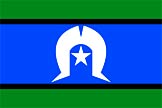
Torres Strait Islander flag. The colours represent the people, their environment and culture. Web colour codes: green = #096, blue = #009, black = #000, white = #fff.
The Torres Strait Islander flag has three horizontal stripes with green at the top and bottom and blue in between divided by thin black lines. A white dharri or deri (a type of headdress and a symbol for all Torres Strait Islanders) sits in the centre with a five pointed star underneath.
The flag was designed by the late Bernard Namok from Thursday Island in 1992 and adopted during the Torres Strait Islands Cultural Festival.
Meaning
The two green areas represent the two mainlands of Australia and Papua New Guinea [26], the blue is the blue of the Torres Strait waters, the black line and the dharri head dress stands for the people.
The five pointed star represents the five island groups: Top Western (Gudamaluilgal), Near Western (Malvilgal), Eastern (Meriam), Central (Kulkalgal), and Inner Islands (Kaiwalagai). Used in navigation, the star is also an important symbol for the sea-faring Torres Strait Islander people. The white colour of the star represents peace.
The flag can also be interpreted through the traditional name for the Torres Strait, 'Zenadth Kes'[26]: Zei meaning Australia, Naigai stands for Papua New Guinea, Dagum is the area in-between the two countries, Thowa Thdwa means land mass, Dhari is representing the islanders, and Star stands for the five regions (as above).
History
In June 1992 it was recognised by the Aboriginal and Torres Strait Islander Commission, and in June 1995 the Federal Government proclaimed the Torres Strait Islander flag an official flag of Australia [7].
Copyright
The Torres Strait Island Regional Council (located on Thursday Island) holds the copyright of the flag. It considers requests to reproduce the flag and issues permissions. Contact the council at www.tsra.gov.au.
Official recognition doesn't mean that these flags have equal status to the national flag, still less supplant it [7]. It does not create "nations within a nation". It does mean that the Aboriginal and Torres Strait Islander flags have legal status and protection.
Most importantly, the government's decision tries to say to Aboriginal and Torres Strait Islander people: "You are a valued and unique part of the fabric of our nation."
This means that Australia now had five flags given legal authority under the Flags Act:
National Flag (blue ensign)
Civil Ensign (red ensign, a civilian shipping flag)
Naval Ensign (white ensign)
Australian Aboriginal Flag
Torres Strait Islander Flag
On 14 April 2000, the Defence Force Ensign was gazetted as the sixth Australian official flag.
Fact
The aspect ratio (or proportion) of the Australian flag is 1:2, while that of the Aboriginal flag and Torres Strait Islander flag is 2:3. [27]
Colour-in templates for Aboriginal & Torres Strait Islander Flags
Use this one-page PDF to print a colour-in exercise for your class. Contains outlines for both the Aboriginal and Torres Strait Islander flag and a space where students can put their name.
This site uses cookies to personalise your experience.
If you continue using the site, you indicate that you are happy to receive cookies from this website.