Aboriginal land and sea councils help Aboriginal people get back and manage their land, and are a point of contact for non-Aboriginal people's inquiries.
Aboriginal land councils represent Aboriginal affairs at state or territory level. They aim to protect the interests and further the aspirations of Aboriginal communities.
The Aboriginal Land Rights (Northern Territory) Act 1976 established the basis upon which Aboriginal people in the Northern Territory could claim rights to land based on traditional occupation. The Act established the Central Land Council and the Northern Land Council.
Under the Act, land councils represent Aboriginal people with "statutory authority", i.e. authorised to enforce legislation on their behalf. Land councils also have responsibilities under the Native Title Act 1993 and the Pastoral Land Act 1992 (NT).
New South Wales passed the Aboriginal Land Rights Act 1983 (NSW) which is considered the "most generous legislation", allowing Aboriginal people to claim Crown land that is not needed for any essential purpose. It also set up a network of local land councils and a state land council (considered Australia's richest).
Queensland transferred former reserves under a special form of freehold, held in trust by community councils for their residents. Various amendments from to the Land Act 1962 (Qld), introduced a limited land rights scheme.
South Australia: The Pitjantjatjara Land Rights Act 1981 (SA) and Maralinga Tjarutja Land Rights Act 1984 (SA) transferred land to traditional owners. Prior to that, the Aboriginal Lands Trust Act 1966 (SA) turned reserves into perpetual leases but did not transfer the land to Aboriginal communities.
Tasmania transferred several areas to the ownership of a land council in trust for Aboriginal people via the Aboriginal Lands Act 1995 (Tas).
Victoria: Several acts transferred specific land to Aboriginal communities between 1970 and 1991.
Western Australia: While the Aborigines Act 1889 (WA) empowered the Governor to reserve (but not transfer) Crown lands for Aboriginal people, Western Australia has not passed land rights legislation.
Contrary to popular belief, Aboriginal land councils are not funded by taxpayers. The NSW Aboriginal Land Council has been self-supporting since 1998.
We operate entirely off our own resources, the whole of the system does.
— Geoff Scott, Chief Executive, New South Wales Aboriginal Land Council [2]
Local Aboriginal land councils
A vital part of Aboriginal self-determination are local Aboriginal land councils (LALCs) which support state or territory Aboriginal land councils. Only LALCs can solve Indigenous problems from an Aboriginal perspective and some do so very successfully.
Local Aboriginal land councils are usually closely connected to the communities they serve. They have creative, innovative and constructive ideas on how to support their people towards self-determination.
They manage and deliver a range of support services including housing, legal affairs, employment, training and property acquisition and management.
New South Wales, for example, is divided into 9 regions with 119 local Aboriginal land councils [2].
The boundaries of local Aboriginal land councils were set in the Aboriginal Land Rights Act (1983).
Case study: La Perouse Local Aboriginal Land Council
La Perouse Local Aboriginal Land Council (LALC) is one of the founding LALC’s in NSW. Chris Ingrey is leading the La Perouse LALC and introduces the council, its history and responsibilities.
What Aboriginal land councils do
Among the many tasks of Aboriginal land councils are to
provide a strong voice for the Aboriginal people they represent,
help Aboriginal people get back their country by land claim or purchase,
help Aboriginal people manage their land,
consult with landowners on mining activity, employment, development and other land use proposals,
protect Aboriginal culture and sacred sites,
assist with economic projects on Aboriginal land,
promote community development and improve service delivery,
fight for legal recognition of Aboriginal people's rights,
help resolve land disputes, native title claims and compensation cases,
run the permit system for visitors to Aboriginal land and deal with illegal entry to lands,
pursue cultural, social and economic independence for Aboriginal people,
maintain and enhance Aboriginal culture, identity and heritage.
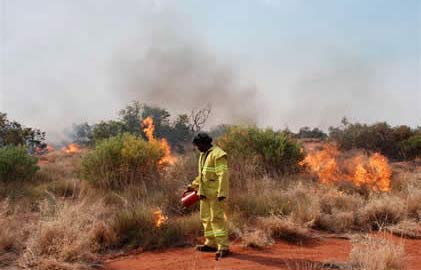
Fire management to maintain their lands is one of the tasks of Aboriginal land councils.. Photo: Central Land Council
an innovative housing program that supports Aboriginal people to stand on their own feet;
an Aboriginal-owned and -run family medical practice that breaks down the cultural barriers that often stand between them and good health;
a learning program to educate Aboriginal people about land management so that they can be employed on lands owned by land councils;
job training programs, and many more.
"These programs combine health, housing, education and employment in a meaningful way that results in real jobs, a better life and self-sufficiency for the participants. Isn't that the goal of the endless line of government programs aimed at Aboriginal people?" asks Jack Johnson, lawyer and CEO of the Gandangara Local Aboriginal Land Council, based in Liverpool, a suburb in south-western Sydney [3].
List of Aboriginal land councils in Australia
Here is a list of state or territory Aboriginal land councils and some more regional councils. Contact them if you have a question or require their help.
Yamatji Bana Baaba Marlpa Land and Sea Council, covering the Murchison, Gascoyne and Pilbara Regions of Western Australia
Goldfields Land and Sea Council: www.glsc.com.au, covering land from Wiluna (on the edge of the Great Central Desert), to Esperance on Australia's southern coast
Ngaanyatjarra Council: www.ngaanyatjarra.org.au, covering communities in the east of Western Australia, but also around Alice Springs, NT
Torres Strait
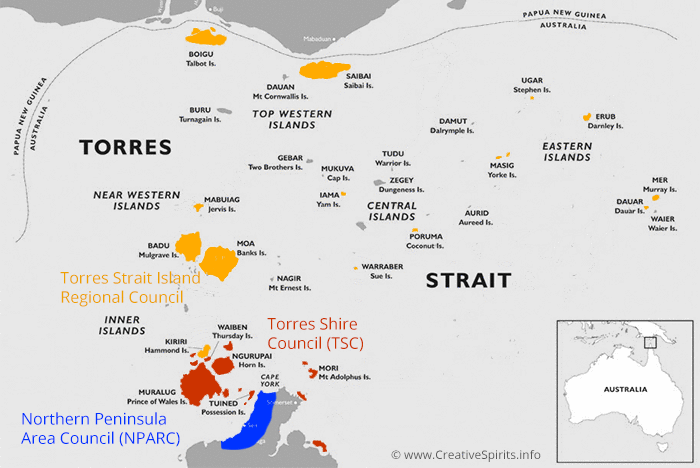
Torres Strait Island Regional Council (TSIRC): www.tsirc.qld.gov.au, representing Badu, Boigu, Dauan, Erub, Kirriri, Iama, Kubin Community at Moa, Mabuiag, Masig, Mer, Poruma, Saibai, St Pauls Community at Moa, Ugar and Warraber
Torres Shire Council (TSC): www.torres.qld.gov.au, representing Albany Island, Dayman Island, Entrance Island, Friday Island, Goods Island, Horn Island, Little Adolphus Island, Mount Adolphus Island, Packe Island, Port Lihou Island, Possession Island, Prince of Wales Island, Thursday Island, Turtlehead Island and Wednesday Island
Northern Peninsula Area Council (NPARC): www.nparc.qld.gov.au is made up of 5 Indigenous communities on the mainland: 3 Aboriginal communities (Injinoo, Umagico and New Mapoon) and two Saibai Islander communities (Seisia and Bamaga)
Torres Strait councils. Most islands belong to one of the three Torres Strait councils.
Join thousands of Smart Owls!
This website is using cookies
This site uses cookies to personalise your experience.
If you continue using the site, you indicate that you are happy to receive cookies from this website.