While the links on the timeline and comparison pages should have made clear that this book is highly controversial if not a lie, why is it so popular?
The analysis
Anne from AussieInAmerica.com analysed reviews on the English site of Amazon. She inspired me to do the same on the German site of Amazon.
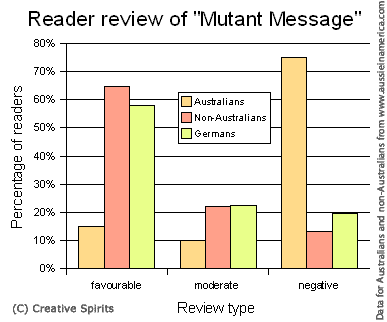
Anne analysed 164 reviews posted between June 1996 and June 2001 on Amazon.com, from which 20 were by Australian and 144 by non-Australian readers. I analysed 148 reviews posted between October 1998 and November 2002 all of which were by Germans or German-speaking readers.
Here are her and my results.
Reader review scores on Amazon. Australian readers posted by far more negative reviews about Mutant Message than Americans or Germans.
Favourable reviews
Anne commented that the favourable readers were accepting the book wholeheartedly, often literally and didn't really care if it was fact or fiction. I made the same finding in my analysis. Readers expressing a favourable opinion often rated the "message" of the book far higher than its truthfulness or lack thereof.
"This book is not based upon facts? - So what?"
"Fact or fiction - I don't care!"
It is appalling how some of the readers derive a lot of "knowledge" about Aboriginal people from this book.
"This book illustrated the culture of the Aboriginals very well. I recommend it to everyone who wants to get an overview about this people."
"I believe instantly that these people can heal broken bones solely through their belief and that they can find and receive everything they need for life 'only' through their belief in mother nature."
"...and one learned a lot about the Aboriginals and that these people can do little miracles."
Moderate and negative reviews
Those with a moderate viewpoint mostly criticised the author's weak style of writing or naive presentation. Few commented on whether Morgan's claims were true or not.
Readers who reject the book make up the smallest group. Some do so because of its style, but the majority notes that the book is not based on fact but rather made up. Of the almost 20% very few mention the Aboriginal peoples' opposition or the Dumbartung's campaign, while even fewer mention Dumbartung explicitly.
"Shortly after my two-month stay in Australia I tried to find again part of the charm of this great continent in the book [...] To report about it is not possible. Marlo betrays her friends with this book and harms their confidence, following her own selfish and communicative instincts."
"In Australia, however, I could convince myself of the vanity of the truth of this book. A bookseller from Darwin was very annoyed about the success of this book, Mrs. Morgan had never been in Australia and would be far too fat in order to survive such a journey in the desert."
Conclusion
While the Non-Australian readers of the English book and German groups are very much alike, the Australian group, though much smaller in numbers, shows a completely different view: 75% negative. This leads to the conclusion that the perception of Aboriginal Australia seems to be very different outside Australia, where most of the copies of the book have been bought. (At Amazon the sales rank of the English copy is at position 5,999 (USA) and 6,939 (UK) whereas the German version is at 608 [January 2003].)
To my mind, this obvious difference in the perception of Aboriginal Australia by people outside this country is due to the following:
Non-Australians are often not very well informed about Aboriginal Australia. An indication of this is that many visitors climb Uluru (Ayers Rock) although a large sign discourages them from doing so. Many do not even now that the rock is sacred to the Aboriginal people.
The magic of the "otherness" of a distant country contributes to its distorted visualisation. Wrong or questionable parts of the text are faded out. Readers of the book, especially women, identify completely with the author, indeed, they are Marlo Morgan and do the journey either with her or in her place:
"...I would have loved to be this woman when I read the book and I believe I was with her on this mysterious travel..."
"While reading I have seen myself again and again next to this woman as if I would travel together with her through the desert."
"Best of all I would change with the main actress and experience everything she experiences."
John Williamson, a well-known Australian singer, gives another hint in his song "Raining on the Rock", in which he also identifies with an Aboriginal traveller:
"...and it's raining on the rock / in a beautiful country / and I'm proud to travel this big land / as an Aborigine /..."
This analysis shows how important it is to make the circumstances, which surround the book, known to its readers. I can only encourage you to point as many people as you can reach to read about the Dumbartung's campaign, their website and maybe mine.
Join thousands of Smart Owls!
This website is using cookies
This site uses cookies to personalise your experience.
If you continue using the site, you indicate that you are happy to receive cookies from this website.