Creative Spirits logo

Aboriginal law & justice

If Aboriginal customary law and white law come together and recognise one another, they can change the direction everything is heading in. —Yidumduma Bill Harney, Aboriginal lawman [2]

Aboriginal law and justice statistics

83%
Percentage of the prison population in the Northern Territory which is Indigenous [9]. The NT has the highest incarceration rate per 100,000 people [14].
26%
Percentage of the prison population in Australia which is Indigenous [14]. Aboriginal people make up 2.5% of the Australian population.
14
Times an Aboriginal person is more likely to be locked up than non-Indigenous Australians [10].
58%
Percentage of juveniles detained in Australia who are Indigenous [18]. Same figure for WA: 74% [28]. Same figure for NSW: 56%. Percentage of NSW population: 4.4% [20].
70%
Percentage of youth in prison who have been sexually assaulted as children [19].
48%
Percentage by which the Indigenous imprisonment rate of NSW rose between 2001 and 2008 [20].
7
Times an Aboriginal person is more likely to be the victim of a homicide than a non-Aboriginal person. One in 10 homicide victims is Aboriginal. [30]
18%
Percentage of Aboriginal homicide offenders in 2007-08. Aboriginal population share: 2.3%. [30]
28%
Percentage of young people in juvenile detention who are Aboriginal [31]. Same percentage for NSW: more than 50%, for Western NSW: more than 80% [32].
33%
Percentage of people involved in police custody incidents who are Aboriginal. [31]
92%
Percentage of Australia's Aboriginal prison population who is male. [14]
$269
Daily cost to the Australian government to keep a prisoner locked up [9].
$271
Daily rate for an Executive Room at the Hilton in Sydney, including breakfast buffet [21].
$1b
Money the NSW government spends each year to maintain its prison system [20].
11
Times an Aboriginal child aged between 10 and 14 is likely to be charged by police [3].
75%
Percentage of Aboriginal people who return to NSW jails after 11 months. 50% of non-Indigenous inmates return to jail after an average of 13 months [26].
28
Times an Indigenous male child is more likely to be placed in juvenile detention [11]. The rate for female children is 24 times [18].
3.6
Average sentence length of Indigenous prisoners in years (non-Indigenous: 5.3) [10].
48%
Percentage of Aboriginal juveniles who end up in court. Same figure for non-Indigenous juveniles: 28% [19].
75%
Percentage of detainees placed in custody before any finding of guilt, sometimes because family circumstances will not allow them to meet bail conditions. Many of the charges do not even carry a custodial penalty. [24].
300
Minimum number of Indigenous people being arrested and taken into custody every week in NSW [23].
10%
Percentage of Aboriginal children who have a family member who has spent time in gaol. [17]

Mandatory sentencing

Aboriginal people and the law: Mandatory sentencing

Read how mandatory sentencing causes young Aboriginal people commit suicide and how it 'helps' jail them for petty crimes with damage as low as five dollars.
Mandatory Sentencing: Read more...

Tribal punishment, customary law & payback

Aboriginal tribal law is often seen as harsh and brutal, but it ensured order and discipline. Payback is the most known form of customary law which has survived until today.
Tribal punishment, customary law & payback: Read more...

Black people, white law:
"I plead guilty"

Aboriginal people and the law: Mandatory sentencing

Many Aboriginal people don't understand white law say they are guilty with no reason to do so.
Read more about Aboriginal people and white law

Aboriginal prison rates

Aboriginal prison rate

Aboriginal people are overrepresented in Australian jails: Over 40% of Western Australia's prisoners are Aboriginal, yet only 10% of the population are Indigenous.
Aboriginal prison rates: Read more...

Aboriginal deaths in custody

A Royal Commission into Aboriginal deaths in custody examined Aboriginal deaths in prison and police custody after concern that deaths in custody of Aboriginal people were too common and poorly explained.
Royal Commission into Aboriginal deaths in custody: Read more...

Circle sentencing

Aboriginal people and justice: Circle sentencing

Circle sentencing tries to break the often deadly prison cycle with a totally new approach to sentencing which spares the offender jail but not punishment.
Circle sentencing: Read more...

Fact Melbourne's William Cooper Justice Centre has been named after a Yorta Yorta man from the Cummeragunja Mission. Mr Cooper founded the Australian Aborigines League, the first political organisation for Aboriginal people. He also helped establish the Day Of Mourning, and in 1938 led a protest of Aboriginal people who walked to the German consulate in Melbourne to denounce the treatment of European Jews by the Nazis. [27]

Aboriginal Legal Service (ALS)

Aboriginal activists and lawyers established the Aboriginal Legal Service (ALS) in 1970 in the Sydney suburb of Redfern.

It was staffed by volunteers who provided free legal advice and representation to the Aboriginal people of inner Sydney.

In 1971, the service received its first government grant for the salaries of a full-time solicitor, a field officer and a secretary. In 2010, 18 lawyers were working for th ALS.

The ALC was Australia's first free legal service, setting the model for mainstream community legal aid. There are now legal services all across Australia. [33]

A unique service offered by the ALS is the Custody Notification Service (CNS).

Gerry Moore holding a speech ALS chief executive officer Gerry Moore on November 19, 2010, when the ALS re-opened its office in Redfern.

Aboriginal youth programs that work

Aboriginal youth is often exposed to domestic violence and abuse which increases the risk of them becoming future offenders.

The songlines that once linked Aboriginal communities have been replaced by trauma lines. —Ken Zulumovski, Aboriginal Men's Healing and Life Skills Program [19]

Taking these young Aboriginal people out to activities can break the cycle, renew their ties to Aboriginal culture and respect for elders.

It is refreshing and encouraging to read a few success stories in the area of law and justice:

"Those kids are now seen as heroes"

When Aboriginal youths destroyed a police truck NSW Aboriginal Liaison Officer Eddie Moore started spending time and talking with them.

He realised that he had to "establish ways of relieving the boredom, of getting the kids off the street and actively involved in things" [12].

One task was to "break the cycle where repeat offenders were often seen as heroes and role models by younger Aboriginal youths and find them other role models".

In 2006 Mr Moore established the Wanga Indingii Program which started with a three-day camp for about 15 Aboriginal boys with activities like spear-making and storytelling. Since then the program has grown into a 12-month structured program for about 40 Koori kids each year.

Aboriginal kids participating in the program are nominated by their schools or youth-related service providers, which encourages the kids to regularly attend school and perform well.

The program monitors the children's school attendance and behaviour and helps them get back on track if there are any problems at school or at home. Through teaching them life-skills and encouraging them along the way these kids complete their courses, thus becoming role models of a different kind to their peers.

A leadership project identifies future leaders in the Aboriginal community among the kids who are then taken to an intensive training. At the end they walk the Kokoda Track (a narrow 96-km track in Papua New Guinea) with seven police officers, a life-changing experience.

Those kids are now seen as heroes and are acting as mentors to other kids. —Eddie Moore, NSW Police Aboriginal Liaison Officer [12]

That's one of the hardest things I'll probably ever do in my life. Everything seems easier now. You think back to when you're over there. You don't need to complain. —Jessica Pratt, leadership project participant [13]

Boys and dogs

In New South Wales a life skills program called Paws Up helps Aboriginal boys to get back on track.

Boys are paired with dogs and both are put through their paces at dog jumping events.

Participants raise and care for their dogs, learning skills and responsibilities along the way, and boosting their self-respect.

Many of the boys participating in the program have moved on to gain traineeships in a range of industries. [15]

"I am a far better person," says Redfern police commander

For some police officers working in Redfern, Sydney's suburb with the highest Aboriginal population, "the suburb's notorious Block is beyond conventional police control" (Sergeant Paul Huxtable) and is the "bag snatch capital" of Australia [1].

But this is only half the story. After walking the streets and acting as a primary contact to Aboriginal people as a Police Local Area Commander in Redfern for 14 months, Catherine Burn said:

I am a far better person because of what I have learned from many Aboriginal people over the last 14 months. My daily walks around the Block and other areas in Redfern have given me a greater understanding of so many troubling issues but have also given me a greater hope that we can move forward and achieve positive change. Catherine Burn, Police Commander

For Catherine breaking down the barriers between police and Aboriginal people is key to "overcome some of the obstacles that have traditionally been present between police and Aboriginal people." This can be done through projects like

and a whole range of other activities. In reference to the young Aboriginal children at Redfern Catherine states:

They are great kids who have experienced more trauma in their short lives than most of us have ever, or will ever, experience. Catherine Burn, Police Commander

Traumas are often caused by domestic violence, drug or alcohol abuse, social and economic disadvantage or cross-generational traumas of the Stolen Generations.

Young Aboriginal offenders celebrate culture

Sydney's Cobham Juvenile Justice Centre has successfully tried another way of strengthening young Aboriginal offenders' self-confidence and cultural knowledge [5].

To prepare the performance of a Dreaming story the group learned about the Dreaming and how to perform traditional Aboriginal dance.

The young offenders learned about their culture and reconnected with their Aboriginal identity. They also learned to share knowledge and developed a better understanding of each other, their self-respect and respect for others.

The program provides a forum for Aboriginal young offenders to develop friendships with other Aboriginal young people in custody, helping them to stay on the right track towards rehabilitation.

Young Aboriginal children performing a dance. Young Aboriginal children performing a dance. Activities like these help young Aboriginal offenders to connect with their peers and develop self-respect and confidence.

Does extra police help?

What happens if more police are deployed to Aboriginal communities?

A study has shown that more police in Northern Territory communities reduced alcohol-related problems, but did little to 'invisible' crimes like marijuana use, sexual assault or stealing [22].

The research found that 'public' problems such as alcohol (46% people reporting improvements) and community violence (45%) had improved most. An interesting finding is that people in remote communities supported an ongoing police presence, with 75% of respondents approving a permanent police presence and 53% believing police did a good job [22]. However, there were vast differences between communities.

Police in some communities are so underresourced that police officers refuse to continue working there [38].

Heavy-handed police

A reoccurring issue between Aboriginal people and the police is the different view of their 'interaction'. Here are two views of the same protest which took place in July 2011 at a site proposed for a gas hub near Broome [40].

Treated like feral animals

A protester said police have been "extraordinarily heavy-handed". "They were bloody terrifying, they basically treated us [Aboriginal protesters] like feral animals."

With respect and care

Western Australia Premier Colin Barnett noted that "when some resisted they were forcibly removed but they were treated with respect and care." Mr Barnett had not been present during the protests.

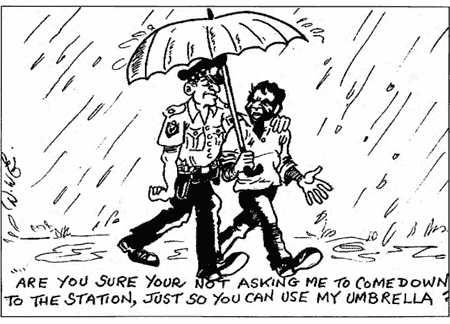
There are numerous examples where police heavy-hands an incident involving Aboriginal people. Officers going too far are rarely brought to trial and often covered by their colleagues.

In one case, Aboriginal people were hunting in an unfenced area in Western Australia. Under the Land Administration Act, traditional landowners are allowed hunting and other cultural pursuits on certain pastoral leases that have embraced their lands. While most station owners are respectful of these rights, in this particular case station staff alerted the police who dispatched two cars, intercepted the group and allegedly 'eye-balled' elders and showed 'immature behaviour' [39].

In Western Australia, Aboriginal people are fed up with the behaviour of police. Marianne Mackay is a Whadjuk woman and deaths in custody campaigner. She says that "in Western Australia, we live under a dictatorship. [Ours] is a racist police force, which is dictated to by the government. The police force is not here for the people, they're here to protect those above us and that's not right. They are public servants, they should start acting like it." [41].

Taser use: "Mr Spratt was screaming constantly"

Aboriginal man Kevin Spratt was tasered 13 times while up to 9 officers surrounded him. CCTV footage showed the unarmed and subdued man screaming constantly.

A week later, while imprisoned, Mr Spratt was tasered again multiple times when officers tried to "extract" him from his cell.

No officers were charged over the incident, despite a police internal inquiry finding that two officers had used undue and excessive force.

Mr Spratt suffered fractured ribs, a collapsed lung, a fracture of the humerus and a dislocated shoulder. [29]

More than 20% of police taser deployments were against Aboriginal people [35,42], and 40% of all taser use involved multiple or prolonged tasering which is more likely to cause damage to a person's health. Queensland police taser about 30 persons each month [42].

However, 67% of assault situations on police could be resolved peacefully after showing a taser [35].

The police taser policy has changed since the incident, and its use is only permitted when there is an imminent risk of serious harm [34].

Others were not so lucky. In 2004 Cameron Mulrunji Doomadgee died after an attack by police officer Senior Sergeant Chris Hurley. Cameron's offence: being drunk and swearing at police.

Not a single police officer in any criminal jurisdiction in the Commonwealth has ever been convicted of any offence relating to an Aboriginal death in custody. Sam Watson Snr, Aboriginal rights campaigner [36]

The very thought of police and the brutality of their enforcement and their arm send absolute shivers of fear up the spines of Aboriginal people. Robert Eggington, Nyoongar leader [37]

Justice? Compare these cases

So you thought you could trust Australia's justice system to be just?

Compensation

Compensation for an Aboriginal woman

After spending more than two years in prison Jeanie Angel, a 47-year-old Aboriginal woman was acquitted of murder [7].

An all-white jury found her guilty in 1989. She never received a formal apology or compensation.

A$0
Compensation for two years in jail.

Compensation for a white man

A man was falsely arrested and detained in police custody over a minor traffic infringement in March 2004 [6].

A district court judge ordered NSW police to pay compensation to the man. His time in jail: three hours.

A$55,000
Compensation for three hours in jail.

Promoted for what?

'From little things big things grow'—such as promotions. Even if the little thing was causing death.

Promotion

In 2004 Senior Sergeant Chris Hurley 'fell' onto an Aboriginal man he was to arrest for being drunk. The man died a short time after.

After three months on paid leave the sergeant resumed his duties on a different post, effectively having been promoted [8].

Demotion

After posting photographs on his Facebook profile of drunk Aboriginal men in custody a Western Australian policeman was stood down from duty and investigated [16].

Mental health at its worst in jail

Aboriginal people already have much higher prison rates than non-Indigenous people. Being in prison causes many problems, and these are worse for Aboriginal prisoners too.

Here's an overview of the traumatic effects of incarceration. Rates are in comparison to the broader Indigenous community [25].

17
Rate of psychotic disorders suffered by male detainees. Same rate for females: 50.
2
Rate of anxiety suffered by male detainees; rate for females: 3.
3
Rate of depression suffered by male detainees. Same rate for females: 4.
9
Times male detainees are more likely to be substance abusive. Figure for females: 20.
93%
Percentage of Aboriginal women in jail who have some form of mental illness. Same figure for men: 81%.
30%
Percentage of Aboriginal women in jail who attempted suicide. Same figure for men: 20%.
33%
Percentage of female Aboriginal inmates suffering from post-traumatic stress disorder. Same figure for male inmates: 12%.

The only positive aspects of being in jail, according to a survey [25], is that inmates are separated from "habit-forming environments" (which includes alcohol and tobacco), have time to reflect, that their basic needs were met, and the chance to participate in sport, education and training.

Some experts suggest that Aboriginal people go to jail because they are already suffering from "serious mental health disorders". This is because "many years of ill-treatment by various Australian governments has resulted in high levels of trauma-related mental health problems." [25]

Any family or group of people that has been decimated by imported diseases, forced removals, slave labour and the loss of their children would be suffering high levels of post-traumatic stress disorder, depression and substance abuse. —Meg Perkins, psychologist [25]

Out of respect for Aboriginal culture I use Indigenous sources as much as possible.
[1] 'Redfern, 90 days after the eruption', The Sydney Morning Herald, 16/5/2004 [2] 'Crime & punishment in Aboriginal law', The Arch (Bond Uni), Spring 2009 p.14 [3] Koori Mail 394 p.16 [4] 'The intervention we had to have', SMH 21/6/2008 [5] 'Young offenders celebrate culture', Koori Mail 444 p.38 [6] 'Police ordered to pay $55,000 for wrongful arrest', Sun Herald, 3/5/2009 [7] 'WA murder compo denied', NIT 12/6/2008 p.6 [8] '2004 Palm Island death in custody', http://en.wikipedia.org/wiki/2004_Palm_Island_death_in_custody, visited 14/3/2011 [9] 'Inmate levels worsen', Koori Mail 454 p.14 [10] 'More in prisons', Korri Mail 467 p.19 [11] 'Calma's final report points to brighter future', Koori Mail 468 p.7 [12] 'Program helps kids walk tall', Koori Mail 436 p.38 [13] 'Going the Distance', MessageSticks, 12/11/2007, ABC1, 6pm, www.abc.net.au/tv/messagestick/stories/s2087835.htm (3/1/2009) [14] 'New approach call over jail numbers', Koori Mail 498 p.9 [15] 'Paws Up to show skills', Koori Mail 495 p.4 [16] 'Cop stood down over Facebook', Koori Mail 495 p.34 [17] NSW Aboriginal Legal Service newsletter, 3/2011 [18] 'More being locked up', Koori Mail 470 p.15 [19] 'Enquiry examines jailing of juveniles', Koori Mail 472 p.37 [20] 'Books plan locked in', Koori Mail 473 p.6 [21] www.hiltonsydney.com.au, visited 6/6/2010 [22] 'Mixed findings', Koori Mail 474 p.15 [23] 'Legal service DVD drama focus on people's rights', Koori Mail 480 p.26 [24] 'Reconciliation in Parliament', flyer, 10/2010 [25] 'Study details trauma', Koori Mail 484 p.15; based on detainees in Queensland [26] 'Push for recidivist programs', SMH 6/3/2010 [27] 'Just honour for Cooper', Koori Mail 483 p.18 [28] '20 years later, and 269 more are dead', Koori Mail 499 p.5 [29] 'WA taser footage shown at hearing', Koori Mail 491 p.16 [30] 'Killings a a far higher rate: Report', Koori Mail 492 p.8 [31] 'Mixed findings in deaths report', Koori Mail 492 p.10 [32] 'More can be done - report', Koori Mail 492 p.37 [33] 'NSW ALS prepares to mark 40 years', Koori Mail 493 p.35 [34] 'Top cop repeats Spratt apology', Koori Mail 500 p.10 [35] 'Indigenous people more likely to be tasered: CMC', Koori Mail 500 p.10 [36] 'Mulrunji protest set', Koori Mail 502 p.27 [37] 'Police 'most racist' in WA', Koori Mail 414 p.11 [38] 'NT death cop admits mistake', Koori Mail 412 p.41 [39] 'Police accused of being heavy-handed', Koori Mail 404 p.44 [40] 'Premier backs police handling of protest', Koori Mail 505 p.8 [41] 'Lound and proud', Koori Mail 513 p.9 [42] 'Taser usage in sporlight', Koori Mail 515 p.12

Creative Spirits acknowledge the Aboriginal and Torres Strait Islander peoples as the traditional custodians of the land in which we live and work.

Related articles