The relationship between First Nations people and police in Australia is tense. Selective targeting, harsh treatment, racism and inappropriate behaviour are the most common issues.
Chance of the public of having a complaint against police upheld. Chances are even less if it is related to physical force. [1]
0
Number of complaints made about excessive physical force which were upheld between 2007 and 2010. [1]
21
Days within which police aims to resolve minor complaints. Serious complaints: 180 days. Percentage of cases that reached that standard in 2010-11: 6%. [1]
50%
Proportion of move-on-notices issued to Aboriginal people in WA by police. [2] Aboriginal population proportion in WA: 3.8%.
25%
Percentage of surveyed Aboriginal people in 2018 who believe they cannot be true to their cultures or personal beliefs in interactions with police and courts. Figure for 2016: 16%. [3]
67%
The number of Aboriginal people charged by police in NSW has increased between 2010 and 2020. Same figure for non-Aboriginal Australians: 8%. [4]
45%
Proportion of First Nations people in NSW police use-of-force incidents from 2018-20 to 2021-22 (First Nations NSW population: 3.4%). [5]
Are police unable to change?
When I found the below excerpt (left side) in an article of The Guardian Australia, [6] it reminded me of the present situation (right side, my words), and how little seems to have changed:
What was...
...and what is
"It was a common and systematic, though largely informal, practice for horse-mounted police to capture and detain Aboriginal people, including women and children, and remove them from pastoral stations.
Their presence threatened the expansion of the cattle industry. At peak periods, from the 1880s to the 1940s, hundreds of Aboriginal people were chained for alleged cattle theft, and marched out of their country, some for up to 400km." [6]
It is a common and systematic, though largely informal, practice for motorised police to capture and detain First Nations people, including women and children, [7] and remove them from public spaces.
Their presence threatens the expansion of any industry. At peak periods, from the 1990s to the 2020s, hundreds of Aboriginal people were incarcerated for alleged petty crimes, and taken out of their community, some for more than 400km. [8][9]
Let's have a look at the present situation in more detail.
Police are heavy-handed & disrespectful
There are numerous examples of police heavy-handing an incident with Aboriginal people, swearing at them or lacking respect – and often all of that at once.
Officers going too far are rarely brought to trial, often covered by their colleagues or superiors, and if they are reprimanded it might be a word with a senior officer a year after the event. [10]
NSW State Coroner Mary Jerram was compelled in one of her reports to point out that police "do not have a licence to act recklessly, carelessly or dangerously or with excessive force". Such behaviour constitutes "an abuse of police powers". [11]
Police records from 2018-2022 of NSW police show that First Nations people were significantly overrepresented in police use-of-force incidents with 45%, at a time when their share of the NSW population was just 3.4%. [5] And the trend is upwards: The percentage increased from 44% in 2018-2019 to 47% in 2021-2022. However, the data is likely too low as police tend to record use of force inconsistently or simply not at all. [12]
In one case, Aboriginal people were hunting in an unfenced area in Western Australia. The Land Administration Act allows traditional landowners to hunt or pursue other cultural activities on certain pastoral leases that have embraced their lands. While most station owners are respectful of these rights, in this particular case station staff alerted the police who dispatched two cars, intercepted the group and allegedly "eye-balled" elders and showed "immature behaviour". [13]
Police have been overheard using extremely coarse language towards Aboriginal youth. “Shut up, motherf––kers. Get on the ground, motherf––kers. Hey don’t move or we’ll shoot you with the gun. [...] Shut up, you want to die?” — This is what police officers said to two 14-year-old boys after they had chased them and stopped their car. [14] Swearing is an offence that gets Aboriginal people frequently into trouble and into jail.
The Norther Territory Police Commissioner, after yet another incident, defended the verbal and physical abuse of his officers towards young Aboriginal teenage boys with the "incredibly hard job" police are doing and deflected criticism by pointing to domestic violence toward Aboriginal women. His superior, the NT's chief minister, backed the Commissioner, adding that "there’s probably no harder judge on a police officer than a fellow police officer". [15] It's a view many human rights and Aboriginal affairs activists disagree with.
Here are a few examples of CCTV and witness footage (Warning: graphical violence and images of Aboriginal people who have died):
No wonder why the community don’t have any faith in policing. Police are supposed to protect and police the community but they are struggling to even police themselves
The use of force is a systemic problem. It requires a systemic solution.
— Samantha Lee, senior lawyer, Redfern Legal Centre [5]
Story:
"There's the bloke who kicked your dad!"
Wongutha and Yamatji actor Meyne Wyatt remembers how police treated his dad, for no apparent reason. [16] Not much has changed.
"In the ’70s, Dad was a bus driver outside of Laverton. Some cops from out of town started beating up blackfullas. Dad took all these Wongi men out bush and told them to hide. When he came back, the cops threw him to the ground and six officers beat him to a pulp and threw him in a cell. He was released without charge.
"As kids, we’d be watching a police press conference on the news and Mum would say casually, “Oh, there’s the bloke who kicked your dad.” It’s a real blackfulla thing to do – you deal with traumatic things through humour."
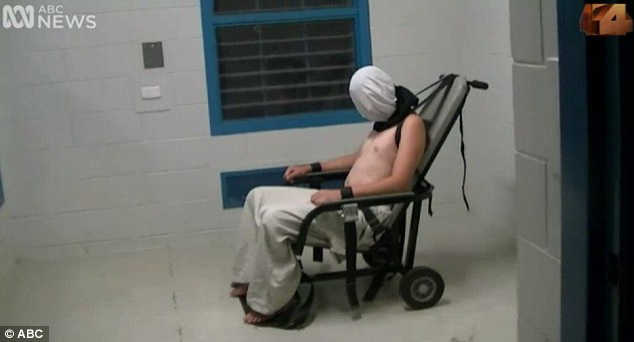
A teenager has been restrained and hooded in Don Dale detention centre, Northern Territory. The United Nations considers such practices an act of torture. Image: Four Corners, ABC
Offences are often trivial
Police arrest Aboriginal people for incredibly trivial offences such as swearing. Even if no charges are laid, such arrests can break Aboriginal people's relationship with police. "Now I see that officer when I go into town and I'm scared he is going to arrest me, there's a real tension there. I don't feel comfortable going into [town] any more", says Robyne Churnside who had been arrested for swearing by that officer. [17]
When Aboriginal people in the remote community of Borroloola collected Christmas hampers that contained alcohol (which is forbidden outside town), police could have informed Aboriginal people at the depot where they collected the hamper that they couldn’t take any alcohol back to their homes. Instead, they called in reinforcements from Katherine, 670 kilometres away, and waited until Aboriginal people brought their Christmas hampers into the Prescribed Areas and then conducted a "detection and seizure operation" where they not only seized alcohol, but also cars. [18]
I'm not sure what damage a thrown sock can do to you, but an Aboriginal man in Meekathara, Western Australia, who was ordered to remove his shoes and socks in the street was seconds later charged with assault when he threw one of his socks at police. [14]
Western Australian Police also issue Aboriginal drivers with more on-the-spot fines than other person in that state which suggests racist attitudes. Aboriginal drivers receive 3.2 times more fines from being pulled over than non-Aboriginal people. But if you compare fines issued based on traffic camera incidents, the proportions are almost even. [19]
That’s the [WA] police’s bread and butter...targeting Indigenous people and making it look like they are doing a lot of work.
— Jim Taylor, former Western Australian police officer [7]
Police harass children
Police coerce kids to react—and know they're wrong. Michael Anderson, Aboriginal leader of the Euahlayi people in NSW, has experienced it first-hand.
"In [far north NSW] towns like Walgett, Brewarrina, Bourke, etc police blatantly target our kids and pull them up for what some of the kids say is nothing, and then antagonise them by making accusations, causing the kids to react, which in most cases results in them being charged with minor misdemeanours. These kids have told me personally that the first thing the police ask for is their mobile phones in order to prevent the kids from recording them." [20] Similar tactics happen in Western Australia where officers provoke Aboriginal people with racist language to "arc them up", as a former officer puts it. [7]
A retired police officer in Western Australia revealed that police routinely targets and harasses Aboriginal people, including children. They round up Aboriginal children without any reason. "They weren’t committing any offence or anything like that ... we were actually exceeding our power by doing that," he admits. The children were "regularly" hand-cuffed "as a form of punishment". Back at the station the officers strip-searched the youth, something they did "pretty much all the time". [7]
Wiradjuri elder Ray Jackson knows the relationship between police and Aboriginal people has always been one fraught with racism, particularly the young.
"Police profile Aboriginal people and target Aboriginal kids from a very young age. They are harassed, abused, physically and morally, by the police and it hardens them up. It's a self-fulfilling prophesy by police, that Aboriginal people are all criminals," he says. [21]
In one case Western Australian police officers abandoned two 14-year-old Aboriginal boys up to 3km outside town after picking them up following a “disturbance”, rather than returning them to their homes. [14]
In another incident, police dragged an Aboriginal university student off a bus "for questioning" because "someone fitting his description" had been seen "looking into cars". Only the prospect of lawyers getting involved made police back up. "And people wonder why Indigenous Australians despise cops," summarises the student's mother her experience. [22]
Such behaviour has already found its way into arts. Aboriginal artist Tony Albert's work We Can Be Heroes 2013-14 comes from the "daily experience" of Aboriginal boys "being followed" and "watched" by police, feeling as if they were "walking targets for bullies, racists and the police". [23] The work shows the portraits of 20 young men with bullseyes painted on their bare chests.
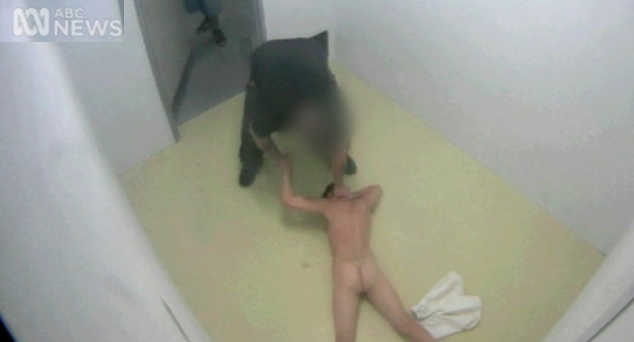
Moments before this teen was pacing his cell. Then three guards entered, pinned him to the ground and stripped him (Don Dale detention centre, Northern Territory). Image: Four Corners, ABC
Homework:
Black youth = guilty adult
Research in the US found evidence that black boys are seen as older and "less innocent" than their white peers.
In one experiment, a group of 60 police officers from a large urban police force had to guess the age of white, black and Latino children based on photographs. The officers were randomly assigned to be told that the children in the photographs were accused of either a misdemeanour or felony charge.
The officers overestimate the age of black felony-suspected children by close to 5 years, but they actually underestimated the age of white felony-suspected children by nearly a year. Black 13-year-olds were often wrongly categorised as adults.
Similar experiments with 169 mostly white students found that "participants began to think of black children as significantly less innocent than other children at every age group, beginning at the age of 10". [24]
Questions
Gather photographs of black youth where you know their age and let someone guess their ages. What do you find?
Does your result change when you repeat the test with another person but tell them the youth committed a crime?
Explore reasons why people might overestimate the age of black youth.
Do you think the same happens with police and Aboriginal youth in Australia?
"The cops don't care"
In Western Australia, Aboriginal people are fed up with the behaviour of police. Marianne Mackay is a Whadjuk woman and Aboriginal deaths in custody campaigner. She says that "in Western Australia, we live under a dictatorship. [Ours] is a racist police force, which is dictated to by the government. The police force is not here for the people, they're here to protect those above us and that's not right. They are public servants, they should start acting like it." [25]
When Michelle Jarrett reported her niece Evelyn missing, the local policeman refused help because his shift was about to end. In another case in the same town, police also dismissed concerns, telling a mother that her missing daughter might have gone walkabout. [26]
Even police officials speak of "the well known animosity between Aboriginal people and police" [26] and a veteran government worker knows that there is "a real sense of fear because Aboriginal people have interactions with police all the time," more than the average Australian. "It's not necessary bad interactions. It could be police knocking on the door looking for someone on warrants. But some [Aboriginal people] are thinking, 'I have all these interactions with police. Are they going to shoot my kids now?'". [27]
And rather than show concern for a family who, through the hands of police, had lost their 19-year-old son, police did nothing. "Police will never get respect back in this community," a resident says. [27]
No wonder Aboriginal people become suspicious of police. Mistrust has been seeded ever since the Stolen Generations and the deaths in custody.
"The cops don't care," says Aboriginal filmmaker Ivan Sen. [28] "There's a lack of connection. That's something that, in my opinion, has been handed down from the Myall Creek Massacre.
"Because of all the social problems around Indigenous people, they spend all their time locking blackfellas up. So when they come to them for help, there's a reluctance. It's like, 'Don't come to me asking for help, I'm trying to find your brother to throw him in jail'."
We have to get rid of racist cops. I don’t want to dwell on the past but I have grown up bitter.
A reoccurring issue between Aboriginal people and the police is the different view of their 'interaction'. Here are two views of the same protest which took place in July 2011 at a site proposed for a gas hub near Broome. [30]
a) Treated "like feral animals"
A protester said police have been "extraordinarily heavy-handed". "They were bloody terrifying, they basically treated us [Aboriginal protesters] like feral animals."
b) "With respect and care"
Western Australia Premier Colin Barnett noted that "when some resisted they were forcibly removed but they were treated with respect and care." Mr Barnett had not been present during the protests.
No government trial, pilot scheme or merely a wish-list will ever succeed, because the police will not allow it to happen if it even remotely threatens their power bases.
— Ray Jackson, President, Indigenous Social Justice Association [31]
Story:
Police laughed on the night he died, says witness
A man arrested with Aboriginal man Terrance Briscoe says he, Mr Briscoe and three other men who had been arrested for drunkenness were in a room with 4 police officers on 4 January 2012 when Mr Briscoe refused to give his name.
After becoming agitated, Mr Briscoe swung his fist at one of the officers. Although he was drunk and the swing only half-hearted, the policeman pushed Mr Briscoe hard on to the ground hand held him face down and sat on his back while other officers put their feet on him, the witness old media.
While on the ground, Mr Briscoe struggled to breathe and began to bleed.
"They were really rough, and they were laughing at the same time," the witness said. "They were making a mockery out of him."
Mr Briscoe was found unconscious just after 2am the same night and died in a hospital the next day. [32]
Story:
Taser use: "Mr Spratt was screaming constantly"
Aboriginal man Kevin Spratt was tasered 13 times while up to 9 officers surrounded him. CCTV footage showed the unarmed and subdued man screaming constantly.
A week later, while imprisoned, Mr Spratt was tasered again multiple times when officers tried to "extract" him from his cell.
No officers were charged over the incident, despite a police internal inquiry finding that two officers had used undue and excessive force.
Mr Spratt suffered fractured ribs, a collapsed lung, a fracture of the humerus and a dislocated shoulder. [33]
In another incident an Aboriginal man was tasered while kneeling in his lounge room with his hands behind his head.
While the officer involved told the court that he used the taser because he feared for himself and two colleagues, the court ruled that police had used "excessive force" and breached police "standard operating procedures". [34] It dismissed all charges against the man.
Here's a short news reel showing video footage of the incident (includes transcript).
More than 20% of police taser deployments were against Aboriginal people, [35][36] and 40% of all taser use involved multiple or prolonged tasering which is more likely to cause damage to a person's health. Queensland police taser about 30 persons each month. [36]
However, 67% of assault situations on police could be resolved peacefully after showing a taser. [35]
The police taser policy has changed since the incident, and its use is only permitted when there is an imminent risk of serious harm. [37]
Others were not so lucky. In 2004 Cameron Mulrunji Doomadgee died after an attack by police officer Senior Sergeant Chris Hurley. Cameron's offence: being drunk and swearing at police.
The very thought of police and the brutality of their enforcement and their arm send absolute shivers of fear up the spines of Aboriginal people.
Here is another case of excessive tasering by police of a 14-year-old Aboriginal youth.
Not a single conviction
There are many instances where police behaviour is questionable. If victims call for an investigation it is usually police investigating police, like in the case of Cameron Mulrunji Doomadgee.
Calls for investigation are not limited to cases involving Aboriginal people. The media are littered with cases where officers were exonerated, commended or promoted after questionable behaviour. [39][40] During court proceedings police officers mislead the public or collude in their version of events.
For example, during a prosecution in 2012, four Senior Constables said a man assaulted one of them at the police station by punching the officer in the face. But CCTV footage showed the punch never happened--instead, the officers forced the man to the ground before one kicked him in the head and another kneed him in the side of his torso. [41]
An inquiry found the officers had shared their accounts of the incident before submitting them, a practice that had been taught by more senior officers. [42]
In May 2014 Elijah Holcombe suffered from a mental episode and was killed by a police officer who panicked and shot him. The event was investigated by other police who found that the officer did not have a legal case to answer.
But when the matter was taken to a coronal inquest the coroner found that the police involved had lied and that the investigating police had fabricated evidence to exonerate the officer who had shot Elijah. [43]
Policing is far from flawless. A former respected police officer identified "unreasonable use of force, failure to investigate, unreasonable conduct, victimisation and misuse of authority" among others as issues affecting policing. [44] Police are also accused to compromise or destroy crime scene evidence. [45]
John McKenzie, chief legal officer with the Aboriginal Legal Service of NSW/ACT, calls for an independent investigative body in such cases. "The Royal Commission into Aboriginal Deaths in Custody called for such a body and it still hasn't happened in any state or territory," he says. [46]
McKenzie says the frequent contact between Aboriginal people and police makes incorrect police behaviour an "ever-present issue" within communities.
Not a single police officer in any criminal jurisdiction in the Commonwealth has ever been convicted of any offence relating to an Aboriginal death in custody.
— Sam Watson Snr, Aboriginal rights campaigner [47]
Fact
On 12 July 2018, the Western Australian police commissioner, Chris Dawson, issued a historic apology to the state's Aboriginal people, taking ownership for “past wrongful actions that have caused immeasurable suffering” and created mistrust towards the police force.
He also acknowledged that "land dispossession, violence, racism, incarceration and deaths in custody have occurred through a history of conflict with Aboriginal people and police". But the commissioner did not address present police behaviour, instead focussing on "police involvement in historical events". [48]
Racism widespread within the police force
Not only elders on the outside and Aboriginal people dealing with cops know that Australia's police force is burdened by a lot of racism. Aboriginal cops experience the same.
One of Western Australia's most decorated Aboriginal police officers, Inspector Geoff Regan, endured "shocking racism" from colleagues during his 27-year career.
“I’ve been called a n–g-er, I’ve been called a boong,” he says. “I’ve had gollywogs [49] in a hangman’s noose left in my locker." He's also been called a "half-breed" and told that he wasn't equal to his non-Aboriginal peers. [50]
Inspector Regan's experience is not usual. A cultural security audit report by academics in 2018 found "horrific racism that exists within WA Police", that training was "largely inadequate" and police needed to "step out of the shadows [of] stereotyping, racism and institutionalised issues associated with law enforcement". [51]
In the community we heard stories of severe racism from frontline officers towards Aboriginal people.
— 'Cultural Security Audit for WA Police' report [51]
Fact
As humans we have a tendency called attentional bias. It means that we focus on certain elements while ignoring others.
Many factors can bias our attention, both external (e.g. a perceived threat) and internal (e.g. hunger or sadness).
Attentional bias is highly relevant to racial profiling and prejudice in policing. Officers frequently perceive First Nations people, especially men, as more dangerous than others, implicitly associating them with crime.
This results in a bias of attention towards First Nations peoples and an excessive perception of 'suspicious' behaviour, leading to more arrests and high incarceration rates.
Landmark Federal Court decision finds police acted racist
It is rare for police to be disciplined. In 2015, Lex Wotton, who has been convicted of inciting a riot after Mr Doomadgee's death, sued Queensland police, claiming the islanders had been racially discriminated against during and after the unrest. He said police had conducted themselves differently because they were dealing with an Aboriginal community.
The Federal Court found that police had indeed contravened the Racial Discrimination Act 1975 (Cth) in their treatment of Aboriginal witnesses, submitting inaccurate information to the coroner, and failing to "communicate effectively" with the community to defuse tensions. Not suspending Senior Sergeant Chris Hurley after Mr Doomadgee's death, and removing him from the island, was unlawful discrimination. [52]
"It's the first time an entire community has been represented in a class action against a state of Australia alleging racial discrimination and being vindicated in that cause," said Lawyer Stewart Levitt, who pursued the discrimination case.
Many angry people were watching the court decision. Aboriginal communities in Western Australia could follow suit.
As long as police officers know that they are treated as a protected species by their governments, their respective ministers, commissioners and their fellow officers that is how they will act.
— Ray Jackson, president, Indigenous Social Justice Association [11]
We've heard it all before
A glance beyond Australia's borders reveals that the relationship between police and black people is tainted by the same issues.
Jon Swaine, from The Guardian in New York, reports that "black residents of Ferguson, Missouri, routinely had their constitutional rights violated through unjustified arrests, traffic stops and other actions carried out by a racially biased police department, the US Department of Justice has concluded, according to multiple reports.
"An extensive federal review of Ferguson’s police force is said to have found that officers disproportionately used excessive force against black people, who were also subject to arrests without probable cause and stops when driving without reasonable suspicion." [53]
To no surprise, 93% of all arrests were of black people, almost nine in 10 uses of force were against African Americans, 95% of people detained at the city jail for more than two days were black--but only 67% of Ferguson’s population is African American.
What can be done to improve the relationship?
Mutual commitments
In 2009, the Ngukurr community in the Northern Territory signed a mutual respect agreement with police[54] aiming to improve relations.
Police committed to mutual respect, regular meetings, improved cultural awareness and community interaction. Elders were to train local police, including information on the location and importance of sacred sites and ceremonial grounds.
Signs of respect
The seed of better relationships between police and First Nations peoples can be small. Raising the Aboriginal and Torres Strait Islander flags in front of police stations is one such seed.
In April 2021, Gosford Police Station became the 12th regional NSW police station to permanently fly the Aboriginal flag. [55] Bourke Police Station followed in June. [56]
First Nations staff
In 2020, Aboriginal filmmaker Cornel Ozies shot the documentary Our Law which follows officers of Australia's only entirely Aboriginal-staffed police station at Warakurna, in remote Western Australia.
Ozies believes that poor communication is at the heart of the problem, fuelled by three factors: a lack of trust, deeper listening and education. [57]
In Our Law, the Aboriginal officers try to learn the local language and develop a rapport with the local people, helping to coach the football team and learning about traditional medicine.
"You're never going to change until you're educated," finds Ozies. [57]
My wish is for non-Indigenous people who want to be involved and engaged to actively educate themselves, seek out the truth behind the anger and frustration.
— Cornel Ozies, director of 'Our Law' which examines policing in remote communities [58]
Is the relationship getting better?
A story from Queensland gives hope that the relationship between First Nations peoples and police appears to improve. Police did not what you might expect and seemed to have been culturally trained on First Nations histories.
When a group of Wangan and Jagalingou traditional custodians occupied the site of Adani’s Carmichael coal mine for several weeks in 2021 and began a long cultural ceremony within its boundaries, Adani accused them of trespassing and called the police. [59]
But officers told the group that they recognise their cultural rights to conduct ceremony, under provisions of the 2019 Queensland Human Rights Act. An officer expressed sympathy with the group's struggle to maintain culture and that police had "no intention at this time" to remove the group. In fact, the officer promised "to support" and "meditate" between the two parties.
Join thousands of Smart Owls!
This website is using cookies
This site uses cookies to personalise your experience.
If you continue using the site, you indicate that you are happy to receive cookies from this website.