Creative Spirits logo

Aboriginal languages

11%
Percentage of Aboriginal or Torres Strait Islander people mainly speaking an Aboriginal language at home in 2008, unchanged from 2002 [24].
50%
Percentage of Indigenous people in some remote areas of Australia whose speak an Aboriginal language at home [1].
62%
Percentage of Aboriginal adults who identified with a clan, language or tribal group in 2008. Same figure in 2002: 54% [24].
804
Number of people in NSW who identified as speaking an Aboriginal language in the 2006 census. Same figure in 2002: 2,682 [25].
20%
Percentage of surveyed West Australians who support the inclusion of Indigenous languages as part of the school curriculum [28].
250
Number of Aboriginal languages spoken in Australia before invasion [16].
145
Number of Aboriginal languages spoken in Australia today. 110 of them are "critically endangered" [28].
70
Number of Aboriginal languages and dialects spoken in New South Wales before the arrival of Europeans [8].
20
Number of Aboriginal languages spoken in New South Wales today [8].
10
Number of Aboriginal languages in NSW considered healthy enough to be included in school curriculums [11].

When I speak language, it makes me feel [at] home.—Roger Hart, Aboriginal elder [5]

Language and Aboriginal people

Aboriginal people are experts when it comes to language. Before the invasion many were able to speak at least two or three and up to five languages or dialects fluently. Because they had an oral culture they were masters in remembering, contrary to the dominant western culture today who relies on the written word.

"[Aboriginal] language is an important embodiment of cultural heritage, knowledge, tradition and identity unique to Aboriginal and Torres Strait Islander peoples," says Russell Taylor, Principal of the Australian Institute of Aboriginal and Torres Strait Islander Studies (AIATSIS) [18].

Even if language is acquired later in life it can instill a sense of wellbeing and belonging for many Indigenous people who have lost ties to their culture [23].

Aboriginal people "often don't even know that [their mother] language is still strong and people speak it. When we show that to them it just blows their mind," says Ken Walker, NSW North Coast Gumbaynggirr Aboriginal language teacher [23].

Yolngu [north-Australian] language is our power, our foundation, our root and everything that holds us together. [It] gives us strength; language is our identity, who we are. Yolngu language gives us pride. Language is our law and justice.—Yalmay Yunupingu, Aboriginal teacher [10]

In the language are our ideas and we need them, the world needs them.—Bruce Pascoe, Aboriginal teacher [15]

Many Aboriginal languages are lost. Early attempts to document Indigenous languages usually focused on simple word lists for novel items such as weapons and animals.

First Fleet officer William Dawes is a notable exception. He recorded conversational snippets of the Darug language spoken around Sydney that tell of the social and cultural contexts, personalities, actions and feelings of the Aboriginal people he interacted with [25]. Dawes was taught by a 15-year-old Aboriginal girl named Patyegarang. See www.williamdawes.org for more details.

Map of Aboriginal Australia showing language groups. Aboriginal Australia language map. The AIATSIS compiled this map showing many of the language groups or nations that existed before invasion. The map is very popular and a good starting point to explore the diversity of Aboriginal Austalia. Purchase a copy

Teaching Indigenous languages at school

At schools in Western Australia, for example, the school curriculum includes up to three Asian languages, but there is no formal inclusion of any Indigenous language. If an Aboriginal language is taught it is by agreement between individual schools and Indigenous language teachers or speakers [28].

But student numbers are encouraging with 6,400 WA students studying an INdigenous language compared to 4,000 students learning Mandarin [28].

They were just so hungry for the Nyoongar language we taught in school. We taught them the whole program and they just loved it. —Janet Hayden, Nyoongar Elder and language teacher [28]

Ms Hayden continues: "They wanted more and more, and when we left the teachers all said 'please come back, don't forget us', and that was in a white community. One very distinguished gentleman came up to me and he had tears in his eyes and said I had opened his eyes to Aboriginal culture and what Aboriginal people were all about." [28]

We see the teaching of languages in schools as being critical to the maintenance of Indigenous languages and to the maintenance of our overall cultural identity as Australians. —Andrew Thompson, spokesman Western Australian Education Department [28]

Aboriginal language: When yes means no

We know that some women say 'no' and mean 'yes'. But it might surprise you that many Aboriginal people say 'yes' and mean 'no'.

Research uncovered that Aboriginal people often answer 'yes' to advances by salespeople to appease the salesperson and politely end the conversation [29]. Salespeople however took their 'yes' as agreement and sealed the contract with dire consequences.

Hundreds of Indigenous people entered unintentionally into exploitative, unfair contracts to buy, lease or lay-by products and services they can't afford and don't understand. The North Queensland-based Indigenous Consumer Assistance Network (ICAN) cancelled more than 800 contracts, preventing an estimated $2 million of financial detriment [29], which they consider the 'tip of the iceberg'.

Similarly, Aboriginal people 'agree' in everyday conversations with non-Indigenous people. They try to politely tell the person that they do not want or can't answer their questions or request because they haven't built enough trust yet or it is not their call to reveal the answers.

Aboriginal words in Australia's language

Article heading: 'Deadly vibe hits Albany' Article heading in an Indigenous newspaper. What would you associate with this heading? [20]

What would you associate with the heading above? Shouldn't the faces of the people pictured be concerned rather than happy because of the 'deadly' vibe that's impacting the town?

This is an example for how Aboriginal words can be mistaken by speakers of the English language. 'Deadly' is an Aboriginal slang word for 'fantastic', 'great' or 'awesome'. The article reports about the fun and joy people had at the two-day Aboriginal youth weekend Vibe 3on3.

While an increasing number of parents are using Aboriginal words for their children's names [23] many Australians don't know how to say 'yes' in any of the many Aboriginal languages.

We all know how to say yes in Spanish don't we? We all know how to say yes in German don't we? We all know how to say yes in French don't we? Do we know how to say yes in any of the 360 Aboriginal dialects in this country?—Ernie Dingo, Aboriginal actor and Yamatji man [27]

Some of the many words you find in Aboriginal English spoken in New South Wales shows the following table [19].

Aboriginal words common in NSW
Aboriginal English Standard English
country land, home
deadly fantastic, great, awesome
mob family, kin, group of people
lingo Aboriginal language
Sorry Business ceremony and rituals associated with the death of a loved one
gammon pretending, kidding, joking
shame embarrass, humiliate
tidda girl female friend, best friend, peer
sista/sister girl female friend, cousin, peer
brotha/brother boy male friend, cousin, peer
dubbay, dub girlfriend, female partner
gubba non-Aboriginal person
duri (doori) sex
charge-up, charge drink alcohol
shame, shamejob that's embarrassing
gunjies police
mish mission
The Waratah is a red, large flower. Waratah. 'Waratah' is an Aboriginal word which is used in today's Australian English. It describes a stout, erect shrub which may grow to four metres. The Waratah was proclaimed the official floral emblem of New South Wales on 24 October 1962.

Australia's language is interspersed with words that come from Aboriginal languages. Today around 400 words are in common usage which come from 80 different Indigenous languages [14]. Most of these words are used to describe flora and fauna or other 'things'.

A survey of newspapers in July 2007 found that the most common Aboriginal word is 'kangaroo', followed by 'wallaby' (which might be influenced by the rugby team of the same name), 'waratah' (also a rugby team), 'koala', 'billabong', 'kookaburra', 'dingo' and 'wombat'.

Not surprisingly, all of these words come from a language spoken in the area of Sydney and surrounds where they were adopted early on in Australia's history. The uniform spelling was established in the 1830s.

'Karrikins' - a new word from an Aboriginal language

Aboriginal words are still added to the Australian and international vocabulary.

In 2008 the word 'karrikins' was added [17]. It is derived from the Western Australian Noongar word karrik, one of the first recorded Aboriginal words for smoke from the Perth area in the 1830s. Karrikins describes a substance in plants that stimulates seed germination and seedling growth after bushfires.

Second only to the original language of Sydney Cove, Noongar has given more words to the English language than any other Indigenous Australian language.—Alan Dench, Professor of Linguistics, University of Western Australia [17]

Aboriginal place names

Aboriginal place names are very, very old. Place names were an important part of Aboriginal culture. If you knew the place names and how they connected you could walk the country and orientate yourself. Song lines were a chain of place names.

After invasion many Aboriginal place names have been replaced by European names and many have been lost or are in danger of being forgotten.

Aboriginal place names: Ayers Rock changed to Uluru. Aboriginal place names reclaimed. Ayers Rock was renamed to Uluru in late 1993 and has become the dominant name for this place since.
Photos: Glenn Livett, Philip Greenspun (bottom)

Some place names have been reclaimed, the most prominent example of which is Uluru. Previously known as Ayers Rock its Indigenous name Uluru was re-introduced on 15 December 1993 with the dual name 'Ayers Rock/Uluru', reversed to 'Uluru/Ayers Rock' on 6 November 2002. The first name of dual names is the official or "dominant" name and should be preferred [31].

In Sydney, about 100 place names around Port Jackson and Botany Bay were learned from Aboriginal people, but only a few came to be used officially, such as Parramatta, Kirribilli, Bondi, Wooloomooloo, Coogee, Maroubra etc.

But some of these Aboriginal place names might not even denote that place because after federation the interest to add a "distinctive national flavour" to the landscape led to many names being introduced with little regard for whether or not they derived from the locality in which they were bestowed [32].

For example, the Aboriginal name Katoomba was moved some 15 kilometres to replace the uninviting name 'The Crushers' whilst the true Aboriginal meaning of Katoomba was lost.

Fortunately there seems to be a tendency to use more Aboriginal place names for new sites, such as the development of the western harbour area in Sydney, known as Barangaroo, which won against the suggested 'Hungry Mile'. State place-naming policies now favour to re-instate authentic Indigenous place names. "The use of Aboriginal names is encouraged and the collection and compilation of recorded Aboriginal place names is supported," read the Northern Territory Rules of Nomenclature for example [31].

Fact: Canberra is the only capital in Australia with its name rooted in Aboriginal language and supposedly derived from the word for meeting place (although there is some disagreement about this).

Why Aboriginal languages lose out

Many Aboriginal people speak English as their third or even fourth language. They grew up learning Indigenous languages as their mother tongue.

These students struggle in English-only schools because they have difficulties understanding what the teachers explain. Consequently they fall behind those students whose first language is English. Unfortunately only nine out of 60 remote Aboriginal schools offer bilingual classes [10] which have been successful in allowing children to attain good academic results on the basis of their own language and culture [13].

"It is widely regarded that the most effective education for Aboriginal students was the mission days when the teachers learnt the local language and used it to teach English," said Syd Stirling, Northern Territory Education Minister in 2005 [12].

Fewer and fewer Aboriginal languages are taught due to the omnipresence of English and the lack of teaching resources. Some Indigenous dialects die out when the last speaker passes on. Worldwide a language gets lost every two weeks [5], and Australia's Indigenous languages are in grave danger of becoming extinct too.

For most Indigenous children, standard Australian English is an additonal language, which presents a real challenge in the everyday classroom.—Thelma Gertz, Catholic Education Office, Townsville [22]

Aboriginal languages lost in Australia

Question: How many Aboriginal languages existed in Australia before European invasion?

Tell me!

Answer:

over 250 [16].

Linguists say that Australia is the top 'hot spot' for vanishing languages [2].

Australia's Indigenous north with its 153 languages is leading a list of five global areas, along with a region of central South America.

Every two weeks one of the world's 7,000 recognised distinct languages vanishes, often because its last elderly speaker has died.

In 2006 only 804 Aboriginal people out of a population of 148,200 in New South Wales were speaking and Aboriginal language [8].

You can't have a culture without a language.—Aboriginal elder [8]

A man wearing an Aboriginal t-shirt explains it to a group of bystanders. Modern Aboriginal story-telling sometimes involves explaining the Aboriginal-themed t-shirt you wear and what it means.

Lack of Aboriginal language interpreters voids court decision

A South Australian Supreme Court judge upheld an appeal of an Aboriginal man because he was not given a fair hearing due to the lack of qualified translators [3].

Eight times the trial required a language interpreter but only once did one arrive. The lawyer had to ask a sentenced prisoner with little knowledge of the English language to step in, while another prisoner assisted the psychiatrist during his assessment of the man.

The judge ruled that the accused man was 'deprived of his rights'.

"I plead guilty!"—Read what happens to Aboriginal people who don't understand the white law system.

The 'Gubba Man'

The most fearful cry Aboriginal people in north-west NSW could hear in the 1850s was 'Gubbamen' or 'Gubba Man' [4].

This term resulted from an Aboriginal mispronunciation of 'government' and it meant officers were coming to take more children away or do other ills to the community.

The word (sometimes shortened to just 'Gubba') was later applied to all white persons.

Question: Why does the Warlpiri Aboriginal language have no words for saltwater things?

Tell me!

Answer:

Aboriginal languages can only have words for things within their local context. The Warlpiri Aboriginal people live in the central desert area of Australia and have no access to saltwater environments [6].

I visit the communities with my Elders who speak four or five languages.—Maryanne Winton, Gurindji woman [7]

Aboriginal language preservation projects

Traditionally, young children who could pick up languages easily were to become caretakers of many languages.

However, many Aboriginal languages and dialects became extinct because their speakers were forbidden to use native language over many years under white Australian assimilation policies.

Today local radio broadcasters take on a role as Aboriginal language preservers when they communicate information in the first language of their listeners. 42% of people in the Northern Territory listen to community radio each week [9] showing how valuable a first language service is to them.

Besides radio there are other dedicated services to preserve Aboriginal languages.

Without intervention, Indigenous language knowledge will cease to exist in Australia in the next 10 to 30 years. —Tom Calma, Aboriginal and Torres Strait Islander Social Justice Commissioner in 2010 [26]

Yuwaalaraaly and Gamilaraay language project

Thankfully some initiatives are under way to try to revive or conserve some languages. One of them is the Yuwaalaraaly and Gamilaraay language project which tries to teach these northern NSW Aboriginal languages to children. The project's website (www.yuwaalaraay.org) offers stories spoken in these languages, the English translation and some background information on their history.

Many Rivers Aboriginal Language Centre

Another resource is the Many Rivers Aboriginal Language Centre (www.muurrbay.org.au) which aims to support Indigenous languages on a coastal strip from Brisbane to Sydney.

Ngapartji Ngapartji

This language preservation project (speak: 'napatji napatji') is both a stage performance and an online interactive experience.

You can journey into Pitjantjatjara (speak: 'pidjnjara') culture and language by watching short films or songs that have been produced by Indigenous community members and artists. Each clip or song is accompanied by a list of Pitjantjatjara words with their English meanings, pronunciation guides and even guided worksheets.

On signing up you can work at your own pace, continue lessons you've started and check out new content.

Try it—and you can experience yourself how hard it would have been for Aboriginal people when they first had to learn English, specifically as adults. ninti.ngapartji.org

Numerous private language preservation initiatives rarely make it to the headlines. If you are interested it's a good idea to search for Aboriginal language forums.

[This] is a call to tongues, to learn our languages, find its secrets and remember them.—Bruce Pascoe, Aboriginal teacher [15]

Graduate course about Yolŋu language

There are about 8,000 speakers of Yolŋu languages in east Arnhemland. After English, Yolŋu Matha is the by far most commonly spoken language in the Northern Territory.

At Charles Darwin University people from around Australia and overseas learn about Yolŋu language and culture by enrolling in the Graduate Certificate in Yolŋu Studies.

This graduate course is designed to provide an introduction to the life and languages of the Yolŋu nations who live in north east Arnhemland. The Yolŋu Studies program at CDU is taught by a Yolŋu lecturer, from an Indigenous perspective and has been approved by Yolŋu educators and elders. The course covers: pronunciation, spelling, Yolŋu names, basic conversation, grammar, maths, kinship, creation and history, land and ceremony, general principles for communicating with Yolŋu, politeness, respect, rights and responsibility in decision making and negotiation, Aboriginal philosophy of knowledge, education and science. The program is available for study both internally and externally.

Newspaper clip of a grant advert for the revitalising of NSW Aboriginal languages. Newspaper ad asking for submissions for grants for community language projects in NSW [30]. At the same time the Northern Territory government had made it mandatory that the first four hours at school should be taught in English, and not the mother tongue of Aboriginal children.

Indigenous language resources

If you are interested in researching Aboriginal languages check out the website of the Australian Institute of Aboriginal and Torres Strait Islander Studies (IATSIS).

Their Australian Indigenous languages database AUSTLANG allows you to search for Indigenous languages by name, place name or by navigating Australia through Google Maps.
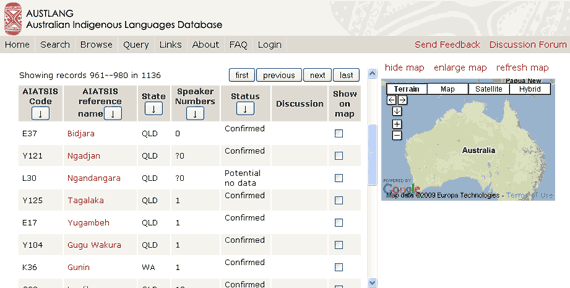
Screenshot of the AUSTLANG website. AUSTLANG website. The site is fast to navigate and offers many ways to explore Aboriginal languages.

Indigenous communities are as diverse as Indigenous languages. —Jimmy Pascoe, traditional owner, Maningrida, West Arnhemland, Northern Territory [21]

Out of respect for Aboriginal culture I use Indigenous sources as much as possible.
[1] Koori Mail 390 p.68 [2] MX Newspaper 19/9/2007 [3] National Indigenous Times 135 p.15 [4] National Indigenous Times 135 p.22 [5] Flyer from Ngapartji Ngapartji performance for Indigenous language support [6] 'A single national language', Koori Mail 429 p.25 [7] 'Toad busters hopping to it', Koori Mail 437 p.12 [8] 'Focus on language', Koori Mail 437 p.31 [9] 'NT community tuned in', Koori Mail 437 p.33 [10] 'NT Govt accused of endangering culture', Koori Mail 439 p.8 [11] 'Volumes offer new hope for languages', Koori Mail 439 p.30 [12] 'Territory re-engages in a decade old bilingual debate', NIT 27/11/2008 p.3 [13] 'Lessons in language', NIT 27/11/2008 p.26 [14] 'Author looks at swimmers, accents and black words', NIT 16/10/2008 p.13 [15] ''Do more' challenge for us all', Koori Mail 441 p.40 [16] 'Aboriginal Languages', NSW Department of Aboriginal Affairs, www.daa.nsw.gov.au/landandculture/language.html [17] 'Noongar name for substance', Koori Mail 444 p.33 [18] 'Prestigious award win for AIATSIS', Koori Mail 452 p.42 [19] 'Working with Aboriginal people and communities', guide by NSW Department of Community Services, 2/2009 p.22 [20] Koori Mail 448 p.44 [21] 'Why homelands are better for our people', Koori Mail 453 p.21 [22] 'Paper highlights the value of culturally inclusive teaching', Koori Mail 458 p.22 [23] 'New language courses reclaim the mother tongue', NIT 25/1/2007 p.13 [24] 'Gains, but the gap is still wide, study finds', Koori Mail 463 p.9 [25] 'Website helps to keep Darug language alive', Koori Mail 463 p.14 [26] 'Calma's final report points to brighter future', Koori Mail 468 p.7 [27] 'Our finalists do us proud', Koori Mail 469 p.11 [28] 'WA support to teach our languages', Koori Mail 472 p.32 [29] 'When 'Yeah Yeah Yeah' means no', Koori Mail 476 p.3 [30] Koori Mail 476 p.32 [31] Northern Territory Rules of Nomenclature, 2001, www.nt.gov.au/placenames/policy/nomenclature.shtml, visited 7/7/2010 [32] 'Place names at risk: Authors', Koori Mail 477 p.34

Creative Spirits acknowledge the Aboriginal and Torres Strait Islander peoples as the traditional custodians of the land in which we live and work.