Annual growth rate of the Aboriginal population. Same rate for non-Aboriginal population: 1.2 to 1.7%. [2]
5%
Indigenous population worldwide.
Aboriginal population figures
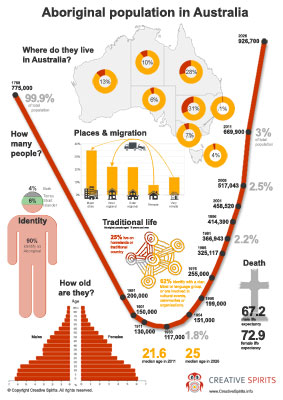
Experts estimate the number of Aboriginal and Torres Strait Islanders at more than 770,000 at the time of the invasion in 1788. [2] It fell to its low of around 117,000 people in 1900, a decrease by 84%.
At present, 3.2% of Australia's population identify as Aboriginal. [1]
Click the image to get this printable A4-friendly infographic about Australia's Aboriginal population.
It took until 2016 for population figures to recover. If the current annual growth rate of 2.2% remains stable, the Aboriginal population can reach more than 900,000 by 2026. [4]
The faster growth in the Aboriginal population (compared to 1.6% for the general Australian population) is the result of several factors and "cannot be explained by demographic factors alone," as the Australian Bureau of Statistics explains. [3] Contributing factors are higher levels of fertility, better life expectancy and more Aboriginal women moving into peak child-bearing age between now and 2026. [4]
The median age for Aboriginal people, currently 23, [3] is projected to reach 25 by 2026. But this remains much younger than the median age in the general population, which is currently 38 and is expected to rise above 40 by 2026. [4]
A problem is though how many people identify themselves as Aboriginal. "There are a large number of people who don't answer the Indigenous question in the Census," explains Patrick Corr, Director of Demography with the Australian Bureau of Statistics (ABS). [5]
It is not unusual for people to identify, de-identify, or re-identify as Aboriginal on official documents such as the Census, making the job hard for statisticians. This phenomenon is also common in Canada, where it explains partially why its Aboriginal population grows up to four times faster than its non-Aboriginal population. [6]
"We have approximately 1.1 million people whose Indigenous status we don't know, so we have made some assumptions," concedes Corr. This uncertainty lets the ABS tag some figures as 'experimental estimates'.
Contrary to what many people think (and to the stereotype of Australian advertising) the majority of Aboriginal people live in Australia's eastern states and not in the remote desert regions of the continent [7].
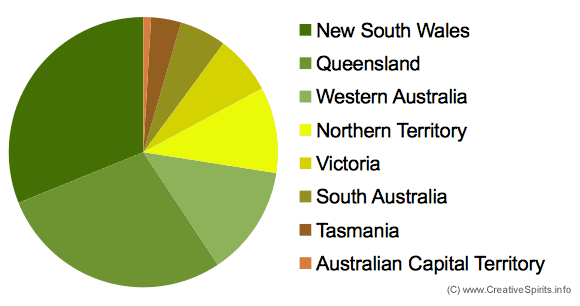
Most Aboriginal people livein New South Wales and Queensland.
More than 68% of Aboriginal people live in New South Wales, Queensland and Victoria while Western Australia and the Northern Territory contribute only 22% of the Aboriginal population. Queensland is expected to overtake NSW for the title of most Aboriginal residents. [2]
The population is the lowest in South Australia (5.3%) and Tasmania (3.6%). The Australian Capital Territory is home to only 0.9% of Australia's Aboriginal people. The Northern Territory has the largest proportion of its population who are Aboriginal (32%), compared with 4.6% or less for all other states and the Australian Capital Territory.
Aboriginal population in Australia. About 60% of Australia's Aboriginal people live in New South Wales or Queensland. The figures are almost stable since 2001. [7]
Myth: Most Aboriginal people live in the outback
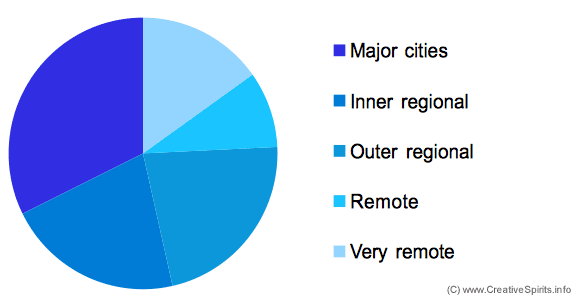
In 2016 the majority (81%) of Aboriginal people lived in cities and non-remote areas, up from 75% in 2006. 37% lived in major cities, 24% in inner regional areas and 20% in outer regional areas. Contrary to what is commonly believed, only a quarter lived in remote (7%) and very remote (12%) areas. [3]
[Non-Aboriginal people] picture red dust, bare feet, dark skin, out on a reserve. But it’s just not the reality. Most Aboriginals are like us, urbanised blackfellas. And they’ve got challenges with drugs and alcohol, depression, suicide, poverty.
— Des Headland, AFL premiership player and Noongar man [8]
Most Aboriginal people live in cities.
However, these general statistics hide the fact that percentages differ vastly for states and territories, as the following table shows. [9]
Urban, regional and remote distribution of Aboriginal people (in %, 2006 figures)
State or territory
Urban
Regional*
Remote**
Australian Capital Territory
100
–
–
New South Wales
42
52
5
Northern Territory***
–
19
81
Queensland
26
52
22
South Australia
48
33
19
Tasmania***
–
96
3
Victoria
48
52
–
Western Australia
34
24
41
* Includes inner and outer regional areas. ** Includes remote and very remote areas. *** Darwin and Hobart are classified as regional areas.
90% of Aboriginal people live in areas covering 25% of Australia, while 90% of non-Aboriginal people live in the most densely populated 2.6% of the continent. [10] (Compare this to who owns how much of the land!)
Aboriginal population numbers are expected to expand more rapidly in urban areas (2.6% a year) than in remote areas (1% a year). [4]
Aboriginal people live in cities, not the outback. It is a common myth that the average Aboriginal Australian lives in a remote community. Only a quarter do so. [11]
More than a third of Aboriginal Australians (36.6%) live among the most disadvantaged 10% of the population and only 1.7% live among the top 10%. [12]
Fact
Of any single region in Australia, western Sydney has the highest concentration of Aboriginal people. According to the census, around 2 million people were living in greater western Sydney in 2006. A little more than 25,000 of them identified as Aboriginal descent. [13]
Age
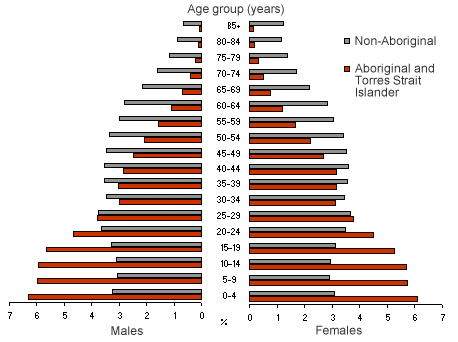
The Aboriginal population is relatively young. In the 2021 census, the median age was 24 years, [1] compared with 38 years for non-Aboriginal people. [3] 65% of the Aboriginal community is less than 30 years old, compared with 39% of non-Aboriginal people. [14] The Aboriginal birth rate is 25% higher than that of all of Australia.
Young Aboriginal people (aged 14–24) make up 5% of the total Australian youth population. A third each belongs to the age bracket of 10–14, 15–19 and 20–24. [15]
Just 4.8% of the Aboriginal population are over 65 years old, [16] while 14.1% of non-Aboriginal Australians are in that age bracket. [17] For 2021 the median age is expected to increase to 24 years, [2] and the elderly population to double.
Aboriginal population distribution. The much younger age structure of the Aboriginal population is largely a product of relatively high levels of fertility and mortality compared with the non-Aboriginal population. [17]
Aboriginal households
In 2016 the average size of Aboriginal households was 3.2 persons, [16] while it was 2.6 in non-Aboriginal households for 2011. [11]
Three-quarters (75.1%) of Aboriginal households were one family households. Just over a quarter (26.6%) of Aboriginal households were couple family with dependent children and a similar proportion (27.1%) was families without dependent children. [11]
One parent families with dependent children comprised 21% of all Aboriginal households, while 14% were lone person households.
Origin
91.4% of Australia's Aboriginal and Torres Strait Islander population identifies as Aboriginal people (coming from mainland Australia), 4.2% as Torres Strait Islanders (including far North Queensland) and 4.4% of both origins. [1]
The percentages are the same among young Aboriginal people. [15]
Ancestry
The 2016 Census of the Australian Bureau of Statistics allowed respondents to report up to two ancestries.
With that in mind, Aboriginal people in Australia reported their ancestry most commonly as Australian (45%), English (17.2%), Australian Aboriginal (15.8%), Irish (5.2%) and Scottish (3.5%). [16]
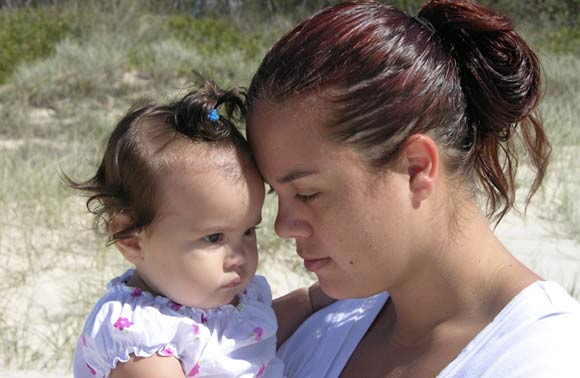
Aboriginal population is on the rise. The Australian Bureau of Statistics expects it to increase by 204,000 in the next 15 years. [2] Photo: bcadoption.com
Human Development Index
The United Nations use a way of measuring and comparing the development of countries by combining indicators of life expectancy, educational attainment and income into a composite human development index, the HDI. The lower the number the better off the country is.
The UN publishes the HDI annually since 1990. While the result looks very good for Australia, it's a very different story when considering Aboriginal people separately.
According to the UN, indigenous peoples in several countries "lag significantly behind the general populations", a discrepancy that is "particularly pronounced in Australia". [18]
Human Development Index 2001
Country
Index for entire population
Index for indigenous population
Australia
3
103
United States
7
30
Canada
8
32
New Zealand
20
73
Analysing odd population figures
Joe Lane took a close look at Australian Census Aboriginal population numbers. [19] He thought they were odd.
The National Census counts Aboriginal people since 1971. But there's an oddity: While you would expect population numbers for each age group to fall over time due to mortality, numbers have risen from one Census to the next as Aboriginal people aged.
For example, the 1971 Census recorded 18,873 Aboriginal people in total. By 2006 mortality would have reduced that number to about 15,000. But the 2006 Census recorded 30,783 Aboriginal people born between 1966 and 1971 – more than double the number expected.
The same applies to all age-groups between 1971 and 2011. But why?
Most likely Aboriginal people re-identify with their culture, i.e. if they previously did not identify as Aboriginal they do so in later surveys.
Assuming the 2011 Census figures are reliable one can then work backwards to establish more reliable population figures for earlier years. Doing so yields figures more than twice the original Census estimates. Instead of the Aboriginal population growing from 106,290 in 1971 to 548,370 in 2011 (more than 5 times), the total Aboriginal population in 1971, identified as Aboriginal or not, was more like 300,000 to 320,000, or about 3 times the original figure. That means the population grew not 5 times, but between 1.7 and 1.8 times.
If this analysis is roughly right, the annual population growth is much less than the official 4% and more like 1.6 - 1.8%. This means the proportion of Australians who are Aboriginal has probably not risen in those 40 years: it has always been around 2.4%, and the Aboriginal birth-rate has not been 3% per year but more like 1.6 - 1.4%.
Homework:
Is this correct, Sherlock?
A report contains the following two paragraphs: [20]
"Currently, the Code’s clause 8 requirements apply specifically to customers in remote Indigenous communities, reflecting the fact that compared to non-Indigenous people, Indigenous Australians are more likely to live in remote and very remote areas. On most indicators, outcomes for Indigenous Australians worsen as remoteness increases, and there are additional barriers to financial inclusion and literacy in remote Indigenous communities.
"Even so, Indigenous disadvantage is not confined to remote communities, and only a minority of Indigenous Australians – around one in five – lives in remote areas. For this reason, in the recent Code review, consumer groups argued that clause 8 obligations should be extended to apply to banks’ dealings with all Indigenous customers, not only those in remote areas."
Questions
The first paragraph states that Aboriginal people "are more likely to live in remote and very remote areas" while the second paragraph says that "only a minority of Indigenous Australians ... lives in remote areas". Are both paragraphs correct?
Rewrite the paragraphs to remove any confusion, and possible stereotyping, they might cause to readers.
Join thousands of Smart Owls!
This website is using cookies
This site uses cookies to personalise your experience.
If you continue using the site, you indicate that you are happy to receive cookies from this website.