Millions of visitors to Australia want to experience Aboriginal culture, yet most Australians don't care about, are openly racist to, or secretly afraid of Aboriginal people. Why is this so, and why are so many foreigners championing Aboriginal culture and advancement?
Overseas visitors are greatly interested in Aboriginal culture and life. Between 85 and 95% of them want to experience it [1]. They look for an authentic experience with "the world's most ancient, living culture" [2] and want to learn about traditional and contemporary practices.
Visitors explore and buy Aboriginal art or artefacts, view cultural displays, take tours to Aboriginal sites or communities and attend Aboriginal performances.
In 2010 these visitors accounted for 13% or about 700,000 [3], up from 12.6% in 1999 [4]. The largest group were aged under 30 (40%) [3].
"We have had more interest from overseas about this office [Aboriginal Heritage Office] than we have in our own country," says David Watts, manager of the Sydney-based Aboriginal Heritage Office[5].
Most Australians shun Aboriginal culture. In 2010, only 0.5% of domestic visitors sought an Aboriginal experience [3], in 2009 it was about 3% [6].
Where do they go? When Australians book a holiday they want to relax, recharge and indulge themselves, something they don't think Aboriginal tourism can offer them [6]. Many believe "that 'real' Aboriginal experiences can only be found in remote areas like central Australia and the Kimberley" [4].
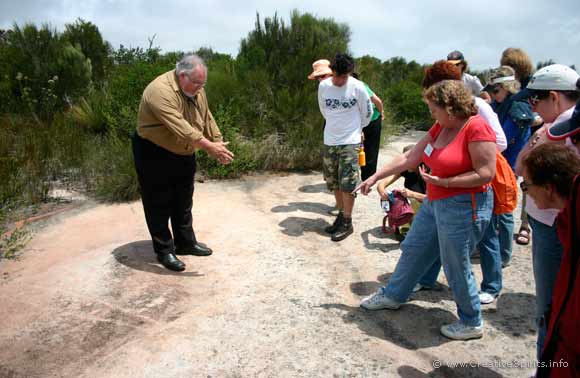
Aboriginal tour. Les Bursill, an Aboriginal archaeologist, explains ancient rock engravings to a group of tourists in Royal National Park, south of Sydney.
Little national support
If you involve yourself in Aboriginal culture or their cause in general you soon notice only few Australians on board.
It seems that far more people from overseas give up their time to support Aboriginal people.
Just four people I know about are a German woman who dedicates most of her waking hours to the Aboriginal cause, a retired Australian-German journalist writing articles, a Taiwanese PhD student researching Aboriginal culture for his thesis and an American woman campaigning for truth over a disputed novel.
Is Aboriginal culture a hot potato?
It's not only ordinary Australians who shun Aboriginal issues. Australia's mainstream politicians, left or right, constantly ignore Aboriginal people's needs and demands.
When the Liberal government started the Northern Territory Intervention in 2006, consultation with Aboriginal people was tokenistic. When a Labour government extended it for 10 more years in 2012 it ignored protests by Aboriginal people, human rights groups, trade unions, churches and tens of thousands of ordinary people.
As journalist Tim Dick puts it: "Many of us [Australians] remain uncomfortable with Aboriginal culture. We're unsure how we relate to it and how it relates to us. We rarely embrace the oldest parts of Australiana in our everyday lives." [7]
This goes all the way to the Prime Minister. “There is a discomfort in our national character," said PM Tony Abbott with reference to Aboriginal culture [8]. "To this day we have not entirely come to terms with this side of the Australian reality.”
Murri activist Sam Watson talks about "inflatable Aboriginals" – bringing out Aboriginal people when it's opportune to show them off (for example during the Olympics), and then deflating and packing them away when the spot lights are out. [9]
Are Australians afraid of Aboriginal culture because it reminds them of the 'wild man or woman' that they are not allowed to express due to their 'tame' British heritage? Do they mourn the loss of their own initiation ceremonies?
An attempt to explain
Why is there not more support for Aboriginal people and their culture from within Australia?
Maybe it all started when Captain Cook declared Australia "terra nullius", a land belonging to no-one. This concept permeates Australian thinking and still forms "the basis of the Australian legal system" [10]. It has been used in land right court cases to find in favour of the Australian government despite "subjective, blatantly racist" evidence [10].
When the "terra nullius" doctrine was overturned by the historic Mabo decision in 1992, it seems to have left a legacy in Australia's conscience. "You did something wrong," it yelled into Australians' ears, and the ensuing media frenzy whipped up the fear that Aboriginal people could legally claim people's backyards.
When white people started to settle in Australia, half the population of NSW in 1828 were convicts and former convicts made up nearly half of the free population [11]. They and their descendants set out to steal
the children of mixed relationships, causing unimaginable trauma that still reverberates today, and
the land Aboriginal people used for thousands of years, with no intention to compensate.
No wonder that 91% of Aboriginal Australians believe past policies still affect them [12], and I believe these policies also affect non-Aboriginal Australians. The collective conscience is aware of Australia's history of abuse of its First Peoples. Australians feel guilty but are unaware of it, unable to express it or simply afraid of it. They certainly don't grieve it.
Guilt and racism
While most Australian people believe it's important to know about Aboriginal culture and are open to learn more, there is not much trust between them and Aboriginal communities. Only 14% of Australians feel there is trust and the general community's knowledge of Aboriginal and Torres Strait Islander histories and cultures is fairly low [12].
Is the subconscious guilt responsible for the lack of trust? Sarah Maddison, author of "Beyond White Guilt", discerns a collective guilt shared by non-Aboriginal people living in Australia, a guilt that is intergenerational [13].
There's a hidden guilt that is passed on through generations - the white generations - and it is slightly, innocently ignorant."
— Stephen Page, director, Bangarra Dance Theatre' [14]
"We're sorry, but only a bit sorry," Maddison says, and "we're not willing to make reparations".
Germans born after World War II never experienced Nazi Germany, yet have to deal with a collective guilt many people attach to them. Many Germans don't dare being proud and celebrating their country. There is confusion what one is 'allowed' to say or feel.
Australians are similar yet different. They deny their contemporary responsibility and hide their shame behind a friendly mask of casual racism.
Like Germans, Australians suppress their guilt. They vent it with anger towards the victims, with separation and exclusion.
"There is still a war of sorts against Aboriginal culture today," observes Maddison, a war which most clearly manifests in the conflicting interests about land. Companies extract the rich resources of Australian soil, but "we can't engage with Indigenous ownership of the land," says Maddison [13]. Terra Nullius still rules the minds of many resource companies' managers.
From an Aboriginal perspective that guilt drives the push for assimilation to this day. "Perhaps these desires [for assimilation] merely arise from the multiple guilts of the invasion and the crimes that followed," ponders Ray Jackson, president of the Indigenous Social Justice Association [15]. "Can those crimes, that national guilt be assuaged by forceful assimilation? Sadly for us the answer seems to be yes! Yes with a hate towards us."
My response to my new knowledge [about Aboriginal affairs] was a paralysing guilt, which took quite some time to work my way through.
— Sarah Maddison, author of 'Beyond White Guilt' [16]
Still I cannot override the guilt I carry from the historical brutality and the recurrent acts of racism of many whites of today. I feel very much as if I am personally in debt to all Aboriginal people.
Many Australians still deny that the Stolen Generations constitute genocide, that massacres occurred all over the continent, and some that Australia was invaded at all.
"The frontier war was not part of our consciousness," says Australian journalist Jeff McMullen [13]. "Our modern nation was born with blood… [But] we are still saying it did not happen."
Is it this denial that makes Australian schools, until recently, not teach pre-Cook Aboriginal existence? The void is filled by overseas educators or the self-study of an open-minded minority.
"Humans are innately wary of those who are different," explains psychotherapist Philippa Perry. "To feel that anxiety is vulnerable-making, Rather than acknowledge our own anxiety, most of us would rather ignore or deny our response, or go even further and marginalise, blame and persecute those we feel to be the source of our ill feeling." [18]
Sigmund Freud explained the reason for this moral blindness clearly: “It is universally admitted that in the origins of the traditions and folklore of a people, care must be taken to eliminate from the memory such a motive as would be painful to the national feeling.” As a consequence, both the process of the dispossession and the recognition that this was a morally serious matter dropped out of national memory [19].
Could it be that Australians are afraid of acknowledging their shadow side--the part of them that once marvelled about going out to "hunt" Aboriginal people, to poison and slaughter them?
It is what anthropologist W.E.H. Stanner in the late 1960s called the "Great Australian Silence" [19].
It is easier to mock than to experience our shame.
It appears the English way to mourn is to say "let's move on". People don't want to deal with pain and busy themselves with anything but the throbbing scar.
When City of Sydney Council for the first time used the word "invasion" in one of their official documents, politicians quickly condemned its use. "I believe the use of that word has served its useful life," said Cr Phillip Black [20] "To continue achievement, attitudes must move on also." The NSW Aboriginal Affairs Minister Victor Dominello commented that "the debate should be squarely focused amongst historians and they can debate the terminology of what took place 200-odd years ago."
Fear of the unknown
When settlers arrived in Australia they hoped to apply British concepts to the Australian landscape. They felt menaced by the desert, the bush and Aboriginal people with their alien customs and they had to find ways to deal with that fear.
One such response is denial.
[Non-Aboriginal Australia] still fears the desert, the bush, the country and its spirits, the different race of its Indigenous people, and they try to compensate for this by planting rose gardens and other activities. There's a lack of understanding of us and what we symbolise.
Listening to Australians talking about Aboriginal people you might hear a lot of blaming. Aboriginal people, Australians say, are themselves responsible for their situation. If only they didn't drink, weren't violent or lazy, didn't spend all their money, their lives would be just the same as anyone else's.
But all this does is create an illusion, the illusion that non-Aboriginal Australians can maintain their current lifestyle, that their hard work, good sense and thrift seemingly protects them from an event in their lives that might lead to the same situation.
It takes guts to break out of this psychologic trick of blaming the victim and take action.
It takes guts because it means taking responsibility for what has happened in the past. But it means also that we take responsibility of what will happen in the future. That can be true reconciliation.
Join thousands of Smart Owls!
This website is using cookies
This site uses cookies to personalise your experience.
If you continue using the site, you indicate that you are happy to receive cookies from this website.