Scratch an Australian to find a racist. It's easy to use racist terms without meaning to. Racism exists at all levels of Australian society but Australians are in denial.
Percentage of surveyed Aboriginal people who believe Australia is a racist country in 2020; [1] figure for 2018: 51%. [2]
43%
Percentage of surveyed non-Aboriginal Australians who believe Australia is a racist country in 2020; [1] figure for 2018: 38%. [2]
42%
Percentage of Australians who reported experiencing racism. Same figure in 2007: 9%. [3]
33%
Percentage of surveyed Aboriginal people who experienced at least one form of verbal racial abuse in the last 6 months. Same figure for 2018: 37%. [2]
19%
Percentage of Australians who think they are a "casual racist" but refuse to change. [4]
35%
Percentage of additional applications job seekers with Aboriginal-sounding names had to submit to get the same number of interviews as an Anglo-Australian applicant with equivalent experience and qualifications in a study in 2009. [5]
26%
Percentage of Australians with anti-Aboriginal concerns. [6]
41%
Percentage of Australians who agree that "Australia is weakened by people of different ethnic origins sticking to their old ways". [6]
11%
Percentage of Australians who don't think that all races of people are equal. [6]
86%
Percentage of Australians who agree that something should be done to fight racism in Australia. [6]
5%
Overall percentage of surveyed Australians opposing multiculturalism. [5]
20%
Percentage of surveyed Australians opposing multiculturalism in the urban fringes where most overseas arrivals settle first. [5]
20%
Percentage of Australian school children who have experienced racism. 50% have witnessed it. [7]
Are Australians racist?
Are Australians truly as open-minded and open-hearted as the world perceives them? Or does a multicultural mentality hide racism? They say that racism always feeds on fear and anxiety...
Read on to discover that racism in Australia is alive, it's only hidden behind a friendly mask.
Fact
Racism is a learned behaviour.
I do not accept that there is underlying racism in this country.
— John Howard, Prime Minister of Australia (1996-2007) in 2005 [8]
I do not believe that racism is at work in Australia.
— Kevin Rudd, Prime Minister of Australia (2007-2010) in 2010 [5]
I don’t want to colour the whole of Australia as a racist society because I think there’s enormous goodwill.
— Josh Frydenberg, Assistant Treasurer in 2015 [9]
Racism is still alive and evil in this country, I can assure you.
— Colin Markham, former NSW parliamentary secretary for Indigenous affairs
60% of surveyed school students in NSW and Victoria in 2019 said they had witnessed racism.
40% of Aboriginal and from ethnic minority backgrounds said they'd been racially discriminated against by their peers.
More than a third of Aboriginal students reported experiences of racial discrimination from wider society. [12]
The many forms of racism
Racism is a snake of many skins. Some are so familiar that we struggle to recognise them. Check which of the following forms you don't know.
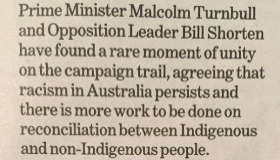
A rare moment of unity as both the Prime Minister and opposition leader agree that racism is a problem in Australia. Image: Reconciliation Australia via Twitter.
Overt racism
Overt racism is easy to recognise because you can identify the perpetrator and their racial violence, slurs, or comments.
Examples:
Asking a person who appears of First Nations descent if they have a job.
Rejecting a First Nations person's application for a sales job because you think they might steal.
Denying access to housing based on the colour of one's skin.
Almost 10% of non-Aboriginal people admit they would not hire an Aboriginal jobseeker. [13]
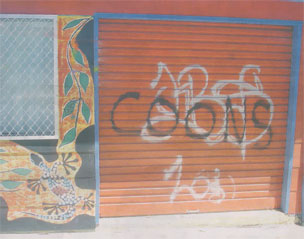
"Racism is still alive and evil." Racist graffiti painted on the gate of a Canberra Aboriginal youth organisation. Photo: Koori Mail [14]
Casual racism is very subtle and often an expression of common prejudices, an expression of "racism deep within". [11] Often going unnoticed, it manifests in jokes or statements about a person's physical appearance, their cultural practices or accents. Almost two thirds of surveyed Australians admit to being casually racist. [4]
Former prime minister Kevin Rudd had to eventually realise that casual racism is an undercurrent in Australia. "It's like a cancer that eats away at the fabric of our society," he admitted. [15] "There certainly is a very strong element of casual racism in Australia," agrees Gillian Triggs, president of the Australian Human Rights Commission. [16]
Someone pulling their wallet out from the coat hanging next to yours, saying “I didn’t feel okay leaving it there”.
A person looking at your bag being scanned, commenting “I really hope I’m not on the same flight as you”.
Others crossing the road when they see you and walking on the other side while repeatedly looking suspiciously over their shoulder.
Australians tolerate jokes or statements and those making them often don't realise their casual racism. But if just one person is offended by a joke, it is racist.
Examples:
"An Australian, an Irishman and a South African walk into a bar..."
"I'm not racist, but..."
Making fun of a person's accent by imitating it.
Commenting on a First Nations person's lateness by saying they've "probably gone walkabout".
Racist slurs are general, derogative remarks about a group of people based on their race. Upon close inspection, most claims are incorrect and perpetuate stereotypes. More than a third of people surveyed conceded they believe Aboriginal Aussies are "sometimes a bit lazy". [13]
Racism and racist remarks serve to bond with people who have the same opinion. Many people who have racist opinions somehow know that these are not accepted in mainstream society so they join political groups who share their racist views.
Casual racism includes racist insults, disrespectful treatment and mistrusting people from another ethic background. How media portray Aboriginal people can also significantly influence our views.
NSW Anti-Discrimination Board president Stepan Kerkyasharian believes casual racism does not help Australians find a mature response. "We tend to deal with some of these issues casually and then, when we realise that it has crossed the line, we tend to panic and go into ‘Oh my god’ mode to re-establish that this is not something we support," he says. [11]
It's almost like our racial discrimination has been hidden under larrikinism.
How often have you heard someone starting a sentence with "I'm not racist, but…"? And what followed was an opinion you thought was racist.
Andrew Johns, assistant coach of the Parramatta Eels rugby team, called an Aboriginal player a "black c**t" but "denied that he was racist". [18]
Mal Brown, an Australian rules footballer, described Aboriginal people as "cannibals" but "declared himself… not racist". [18]
Eddie McGuire, president of the AFL club Collingwood, suggested on radio that an Aboriginal footballer should promote a King Kong musical, but declared "I am not a racist". [11]
No wonder that South African woman Sisonke Msimang, after migrating to Australia, observed: "The levels of racism amongst many white Australians seem to match the levels of denial about their being racist." [19]
American expat, Robbie Blowers, a legal practitioner in Melbourne, offers what he learned after moving to Australia: "One thing I've learnt about my adopted home is that its problem with racism is similar in many ways to America's problem with guns: it is so culturally ingrained that its perpetrators can't even see that it's a problem." [20]
To be racist you don't have to be extreme. "If you are being racially vicious in your remarks about other races, that's racist," says Timana Tahu, an Aboriginal rugby league player with the Parramatta Eels who sparked a nationwide discussion about racism when he walked out of the coveted NSW Origin team camp after Andrew Johns' remarks. [18]
Some people think that using racist slurs is being playful or assume racist words are slang. Racism in Australia is often cloaked by "larrikinism", and Australians are very casual with racism. [4]
Institutional racism (systemic racism)
If companies, organisations or government bodies act in a racist way, either deliberately or indirectly, it is called institutional racism or systemic racism. Their policies, procedures or practices might discriminate, exclude, or disadvantage racially certain people.
Examples:
The South Australian government refused to fund Aboriginal legal aid. The head of the Aboriginal Legal Rights Movement Inc called this refusal institutional racism [21].
A particular government program's structure works for 80% of the population, but not for First Nations people or people from migrant communities because their circumstances don't fit the program's profile, thus limiting their access. [4]
The impact of systemic racism is similar to that of personal racism. People can be (re)traumatised because they are rejected, or even die if they don't receive the health services they need.
In fact, the worst offender of institutionalised discrimination and marginalisation of Aboriginal people is the government.
— Neil Gillespie, head of the Aboriginal Legal Rights Movement Inc, South Australia [21]
Fact
Almost 50% of non-Indigenous Australians believe Aboriginal people are given unfair advantages by the government.
Passive racism
Being passive can also be a form of racism. "The majority of Australians are not racist per se," says Gerry Georgatos, a journalist writing for The Stringer, "however passivity is a layer of racism and that should always remain solid in everyone’s thinking." [22]
Examples:
You remain passive when someone tells a racist joke.
You don't respond when someone discriminates against First Nations people.
You ignore or avoid a person solely based on their race or appearance.
One in five people say they would move away if an First Nations Australian sat next to them. [13]
Complimentary racism
If you are making compliments to a person, but the compliments are about traits that you associate with the racial group only, you can be racist. Often such traits perpetuate aged stereotypes and discrimination.
Examples:
"As an Aboriginal person you must be good at dancing, right?"
"I'm sure you have an excellent memory, given the oral culture you come from!"
"... and I know for a fact that First Nations people are really good at sports."
Tokenistic racism
In a much more informed society and economy, many organisations and businesses are keen to "tick the diversity box" and hire a First Nations employee. If this is only done to tick a box, it is tokenistic and thus racist.
The same applies if you treat First Nations people differently based on context, as the following example illustrates.
"At school, it was OK for me to be Aboriginal when it benefited the school such as during NAIDOC week or for a Welcome to Country," recalls Marlee Silva, a young Kamilaroi and Dunghutti woman.
"But when I talk about January 26 or about issues in my community, my [peers] are very dismissive." [23]
Change is not easy
Realising that we might have racist elements within us is very hard and uncomfortable and not many people are able to admit that, especially in public. It is much easier to pretend that something or oneself is not racist, to preserve the illusion of a perfectly just society, and move on (particularly if you don't regularly experience racism).
Academic Robin DiAngelo calls this 'white fragility' [24] and has written a bestselling book about it. "We have to stop thinking about racism as someone who says the N-word," she says. [25] Some First Nations people on social media can be quick to pull out this term when they respond to non-Aboriginal comments.
"We need to... move away from the standard Australian response of denying racism,” says Priscilla Brice, the managing director of anti-racism charity All Together Now. “By acknowledging that racism exists and learning how to speak up about it, young people can become great role models for the rest of society." [26]
If I'm in a group of 50 people who aren't Aboriginal who crack a joke about Aboriginal people and they all have a bit of a chuckle, I have to say that's unacceptable. We have to call it for what it is. It's racism.
— Prof Shane Houston, Deputy Vice-Chancellor, University of Sydney (Indigenous Strategy and Services) [4]
Tip
Find a copy or recording of the SBS documentary Is Australia Racist? – an hour-long investigation with real-world experiments covering people of colour, muslims and Aboriginal people in Australia.
We are still hearing the same things that my mother was hearing when she was little.
— Timana Tahu, Aboriginal rugby league player [18]
Racism is never really seen, it's only really felt.
Story:
"The conversation didn't tear us apart, we were still mates"
Brandon Jack has been a teammate of Adam Goodes for many years. He recalls what happened in the change room when his team discussed the persistent booing that eventually let Adam quit the AFL. [28]
"After training this week with my university football team, I was sitting in the change rooms with some of the guys and the topic of racism and Adam came up. One player said that they didn’t think it was racist. His view was that the best players have always been booed. That it was a badge of honour.
"As I prepared to respond, something happened. From the other corner of the room a voice called out: 'He said it was hurting him. He felt it was racist. He was made to feel small and isolated and was bullied for standing up against racism. So yeah, I think it was racist.'
"The conversation that followed didn’t tear us apart. We were still teammates who would run out alongside each other on the weekend and, in that moment, we were Australians discussing what we wanted to stand for.
"This documentary is so important because it gives us a voice to respond to racism. To say, no, this wasn’t just another occurrence of football barracking. That this was tainted by deeper animosity. That this was different. That in Australia, we have become far too accepting of casual and even blatant racism."
Can you have such an open discussion?
Give Nothing To Racism
In this cheeky video, New Zealand's Human Rights Commission tells how many small bits of racism add up and calls to stop casual racism from growing into something more extreme. [29]
For Victorian academic and writer Lillian Holt racism is "the gangrene of the soul of this nation which slumbers under the smug surface of this lucky country." [31]. She labels it a "spiritual disease".
Stephen Hagan, Aboriginal film-maker and author, confesses "I'm on public record as saying Australians are the most racist people in the developed world for their treatment of the First Australians and I make this claim comfortable in the knowledge that I am sufficiently supported by incontestable statistical data." [32]
And statistics seem to confirm Stephen's view. The SMH (data above) asked its readers in 2012, and a survey by Western Sydney University in 2016 found that Australians had 'negative' feelings towards Muslim Australians (32%), Middle-Eastern Australians (22%) and Aboriginal Australians (9%). [33] About a third of respondents experienced racism at work, their place of study, public transport or shopping centres. 80% acknowledged that there is a problem with racism, very close to the number the SMH found.
Stewart Levitt, a lawyer for an Aboriginal man, moved his client's trial to Brisbane after he found "entrenched racism in the Townsville community against Palm Island Aborigines" and double standards in Queensland [34].
For Aboriginal elder Uncle Allan Brown racism are "the under-handed snide remarks". People hide racism "more than anything" and don't want to know about it [35].
While filming in Australia, American presenter John Oliver noticed that racism in Australia "is undeniably specific" [36]. Australians complained to him "about all the 'Lebos' in the country", using a derogative term for Lebanese people which is similar to what they use for Aboriginal people ("Abos").
Australia turns out to be... one of the most comfortably racist places I've ever been in.
— John Oliver, American presenter of The Daily Show [36]
Homework:
Can someone be born racist?
Writer Kelly Briggs says: "No one is born racist. Racism is a social construct, it is taught through schools, parents and structurally through the court system in this country." [37]
Questions
Do you agree with Kelly? Why? Why not?
Describe three situations where you were 'taught' racism. Can you think of a new response next time this happens?
How can the court system teach racism?
Some good news
"I do think things are changing," observes Dennis Eggington, head of the Aboriginal Legal Service of Western Australia [38]. "For one thing we have a more informed group of young people coming through," he says.
Interest in Aboriginal culture has risen significantly in recent years, partly driven by better integration into the school curriculum. Students' knowledge and self-confidence helps contribute to, with the words of Eggington, "the changing face of Australian people [which] means the old entrenched colonial racism is being driven out."
A series of disturbing incidents made the Australian Football League (AFL) develop policies for its players, a policy to deal with on-field racial vilification, as well as introduce player and staff education [39]. It contributed to lift the share of Aboriginal players from 5% to 11% between 1996 and 2011.
The National Rugby League in August 2010 announced "tough new measures to combat racism". Any player caught would be stood down immediately and charged with contrary conduct. [40]
Like Martin Luther King, I have a dream. That, one day, a Nyungar family will be born free of racism.
— Dennis Eggington, Aboriginal Legal Service of Western Australia [38]
Recommended reading
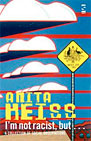
I'm Not Racist But… by Aboriginal author Anita Heiss is a collection of social observations, thoughts and conversations.
The book will challenge you to consider issues of Aboriginal identity, reconciliation and issues around saying 'sorry', notions of 'truth' and integrity, biculturalism and invisible whiteness, entrenched racism and political correctness.
Story:
"Don't mess with Daisy, baby!"
The following story was told by Diat Alferink, daughter of Daisy Alferink, the 'Truckie Fighter' [41].
"My mum was known as the truckie fighter. She used to punch out drivers for being racist in the front bar of the Lyndhurst pub.
"She's this big, strong [Torres Straight] island woman so whenever they said something racist to her, she'd just go, 'puck you' and knock them flat.
"Mum was strong because she'd had to fight all her life as a black woman in this country. I have a memory of this truck driver being flat out on the floor in his singlet and stubbie shorts.
"It's been said that the last thing he heard before he passed out is a voice in a strong Island lilt warning, 'Don't mess with Daisy, baby!'"
Tip
Here is an idea: We need to do some raisism: raising strong and resilient children in the face of racism.
Pauline Hanson's One Nation
One of these political parties was the One Nation party, founded by Pauline Hanson in April 1997. Let's have a brief look at some excerpts from her maiden speech to parliament in September 1996, [42] and why they are racist.
I have done research on benefits available only to Aboriginals and challenge anyone to tell me how Aboriginals are disadvantaged when they can obtain 3 and 5% housing loans denied to non-Aboriginals.
— Pauline Hanson
Racist statements like this show a lack of information and balance. If Hanson had done her research properly she would have found out that Aboriginal housing conditions were nowhere near what the average Australian enjoyed. At the time Hanson spoke, more than 9% of the Indigenous population in rural areas lived in "caravans, shacks and improvised accommodation" and 9% of Aboriginal people's rural homes did not have a toilet [43].
20% of Aboriginal people lived in "dwellings which had eight or more residents" [43]. Compare that to the total Australian population where less than 1% had to live in such overcrowding houses.
I draw the line when told I must pay and continue paying for something that happened over 200 years ago.
— Pauline Hanson
This comment shows a lack of empathy and compassion for other people's situation.
Anti-racism poster. ANTAR invited visitors with this poster to test if they were racist.
Many opponents of Prime Minister Kevin Rudd's apology to the Stolen Generations thought likewise. 'Why me?' they asked. But this misses the point entirely. Rudd didn't apologise because he was guilty personally, he apologised because he felt sorry for what these people had to endure and how they suffered. For Aboriginal people this was a giant leap forward towards healing.
Racist people have trouble putting themselves into the shoes of others. When talking about land rights for Aboriginal people, Hanson said, "Well, where the hell do I go? I was born here." She doesn't even try to understand where Aboriginal people come from, what land means to them. Racism and egotism walk hand in hand.
One of the great things about free speech is that when racists can say what they really think, the public realise how disgusting they are. It's when the law makes them clean up their act that they appear more reasonable and electable.
Anyone who is exposed to continuous racism suffers, no matter if this racism occurs at a young age at school or later in adult life.
Poor health
93% of the people who took part in a three-year study of the Flinders University's Southgate Institute in South Australia reported experiencing racism, particularly within the justice and education systems. [21] Experienced regularly, racism leads to poor health the study found.
It causes stress and negative emotional or cognitive reactions which reduce mental health as well as affecting the immune, endocrine, cardiovascular and other physiological systems. [45] Half of First Nations peoples' psychological stress is caused by everyday racism. [46]
"We found that Aboriginal people do not primarily have a higher rate of illness because they lack knowledge of what behaviours are good for their health," the study's chief investigator, Dr Anna Ziersch says. "Compared with the general population, twice as many Aboriginal people did not drink and most exercised regularly—and yet they had worse physical and mental health."
"We saw evidence that said about 10% of the Australian population in 2004 was reporting regular occurrences of individual acts of racism and that that has now [in 2014] doubled to being close to 20%... We then saw evidence that the consequences of this are increased psychological illnesses. Psychological illnesses tied directly to a person's exposure to racism and discrimination," reports Martin Laverty, Chair of the Social Determinants of Health Alliance, a group of Australian health, social services and public policy organisations. [47]
There's no biological reason why we have the inequity that we do have around health.
— Ray Lovett, Ngiyampaa man and professor at Australian National University [46]
Unhealthy coping strategies
Causing poor health, racism also exposes Aboriginal people to other risk factors associated with ill-health, such as junk food, toxic substances, dangerous goods. [45]
Coping mechanisms – especially for young adolescents [7] – tend to include unhealthy activities such as smoking, alcohol and drug use.
AFL player Adam Goodes knows this only too well. "We've had to put up with a lot [of racism] unfortunately... you become quite tolerant because if you don't you become very angry and you do things you probably don't choose to do," he says. [48] Anger, and indeed rage, is common in people who experience racism daily and builds up over time.
"I have family members who can't take it as well as I can. They react with violence, with drinking, drugs. These types of things are a coping mechanism because people don't understand how much racial abuse can hurt people. It can put people into depression."
At the same time Aboriginal people stop healthy activities like sleep, exercise, or taking medications. [45]
Racism also causes Aboriginal people to not use, or not have equal access to, services for employment, education, housing, medical care and so on. [45][49]
Aboriginal woman Zeritta Jessell from Kununurra, WA, graduated from high school but never went to college because she feared more racist taunting like what she had experienced at school. And Nakkiah Lui, from Mount Druitt in Sydney's western suburbs, nearly quit school because of racist taunting and only continued on because of her mother insisted. [49]
Racism through health care providers or health workers can be a "second layer", [45] and Aboriginal people can be so traumatised they would rather become sicker than return for treatment. [50] One in three Aboriginal Victorians surveyed by VicHealth reported experiencing racism in a health care setting. [45]
Expectant mothers are more likely to have poorer birth outcomes, including babies with a lower birth weight. [7]
Trauma
Racism can easily trigger childhood traumas. Adam Goodes, an AFL player, was taken back to "school stuff" when a fan racially abused him during a match. "I felt like I was in high school again, being bullied, being called all these names because of my appearance," he said. [51]
Story:
She tried to scrub her body to remove her black skin
A 3-year-old Aboriginal girl who was traumatised after she was racially abused in a shopping centre tried to scrub her body to remove her black skin. [52]
Samara was in a queue with her mother when another mother and her two daughters began to verbally abuse the young girl, making comments about her black skin.
"I asked the woman what she meant by the comment and then one of the woman's young daughters screwed up her face, she pointed at Samara and said 'you're black and black is ugly'," recalls her mother.
Samara became upset and started to cry. She refused to attend Aboriginal dance classes and starting taking baths daily in a bid to scrub off her black skin.
"She was requesting to bath every day and she was soaping up to make herself look white" until her skin was red, says her mother.
"She had her Aboriginal dance classes to attend but she didn't want to attend them. I asked her why and she said, 'because black is ugly."
Ongoing racism can lead to heart disease, premature birth, hypertension, mental illness, physical illness or suicide. [53][54][26]
Every Aboriginal person in this country is very angry, day after day, year after year, they keep it at a simmer. If I find a blackfella that's not angry then I'm suspicious.
Three out of four Indigenous Australians experience racism in their everyday lives.
— Gary Highland, National Director, Australians for Native Title and Reconciliation (ANTaR) [53]
Story:
Hard to see that darkie…
Racist stereotypes continue to persist in Australian's minds, even if they are magistrates, as the following story shows [56].
A man struck a woman with his car while she was lying on the ground in a parking lot. He was told by bystanders that she was drunk and would be okay.
The man proceeded his journey with the woman left on the pavement where she later died.
In the Magistrate's Court the man received a A$400 fine and was allowed to keep his driver's license.
In sentencing, the magistrate said: "It's clearly the case that an Aboriginal person in the dark on the bitumen or other places is extremely hard to see... It's easy to imagine how such an accident could happen."
My daughter is 18 and all her life she's had no help from anyone. She went to school being picked on simply because she is Aboriginal. For the past two years, nearly every employer she has applied to for a job has said to her 'Oh, you're Aboriginal. Good luck' and laughed.
Reverse racism is racism against members of a dominant or majority group, that is racism from Indigenous people against non-Indigenous people.
Reverse racism seems to be far less than racism against Aboriginal people. "I've never heard a black player use the same language [as non-Indigenous players use] about a white player," says Timana Tahu, an Aboriginal rugby league player [18].
Microaggression
Microaggressive remarks can often come in the form of back-handed compliments.
For example, "She's gorgeous for a big girl" or "I would never be able to tell you're gay!". Speaking really slowly when talking to a non-native speaker is another example.
Often microaggression requires well-meaning people to reflect on their own bias and privilege. They may object to racism, but not be at all aware that their remarks hurt the other person.
Microaggressions usually stem from misunderstanding or innocence, or may even be well-intentioned, but have the same effect as deliberate discrimination and racism. It is like death by a thousand cuts, however small each one might be.
Video: Too Little Justice
Watch Too Little Justice, a five-minute-video about racism against an Aboriginal youth directed by Dean Francis. Note how an "innocent" comment sparks the altercation, common in real life experiences of racism.
There's not many of us who haven't suffered from racism, horrible overt racism.
— Dennis Eggington, Aboriginal Legal Service of Western Australia [38]
Through my time with the Nyoongar people, I got to see first-hand the ingrained systematic racism in town and it made me sick to see such backward behaviour still existing in what was then the 20th century.
If you haven't already done so read the quotes by successive Australian prime ministers at the top of this page. They are tale-telling proof that politicians have lost touch with reality.
Both politicians and Australian police commonly argue that many of the assaults on people of different ethnicity are 'opportunistic' rather than racist [5].
Australia hasn't had a multicultural policy for 15 years. The Race Discrimination Commissioner is part time, his other responsibility is as the Disability Discrimination Commissioner.
"Our politicians are fixed in denial… Politicians believe there are electoral costs and no benefits to acknowledging racism," says Prof Kevin Dunn, an expert in human geography and race and ethnic studies at the University of Western Sydney. Dunn collected the "most comprehensive data on racism in Australia" [5].
No wonder that Prime Ministers continue to offer glimpses into their true reality, as Tony Abbott did when he stated Australia was "unsettled" before British invasion [60].
Look at how [politicians] responded to the global financial crisis [in 2008/9] or any other problem… they find the problem and tackle it. But not with racism. It seems we [Australians] can be broke, we can be fat, we can be anything. We just cant' be racist.
— Dr Yin Paradies, senior research fellow, University of Melbourne [5]
A study by the Australian National University published [in 2009] found clear evidence of racism in Australia.
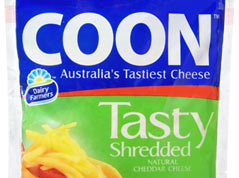
Is this cheese name racist? "COON is Australia's best known cheese brand," says the company's website.
For decades, Coon was a staple in the fridge section of Australia's supermarkets. Since 1931 it was the name of a cheddar cheese. But for a long time its name also caused heated debate.
'Coon' is an insulting term for Aboriginal people and is believed to come from the 1850s Portuguese term 'barracoons' which describes a place of temporary confinement (usually a cage) for slaves or convicts in which they had to wait before being sent away to the places they were due to work.
It could also have meaning as a shortening of 'raccoon', a Washer Bear native to North America. The black eye masks and nocturnal habits of raccoons, along with their tendency to steal, paralleled the characteristics of typical robbers and thieves.
Is a call for Coon cheese to change its name political correctness gone mad?
Yes, people need to get over it, it's just a name
93%
No, there's a reason we can't use words like that any more
6%
2,390 votes, news.com.au/heraldsun, October 2008
No matter what you believe personally, results often depend on how you ask the question. The Herald Sun in its online poll asked "Is a call for Coon cheese to change its name political correctness gone mad?"
Note how there's no mention of the name being racist. No mention of Aboriginal people being offended by the name. The Herald Sun asks if it is overly political correct to ask for a name change. From this angle many people might agree, given the fact that the brand has been around for quite some time.
Note also how the options given to the users of the poll suggest that one should "get over it" and move on and doesn't explain what the reason is why we cannot use "words like that" anymore. For the passing surfer this poll is totally useless in the absence of context to the question.
Coon becomes Cheer
Cheese manufacturer Saputo Dairy Australia says its product 'Coon Cheese' (sold only in Australia) was named in 1926 after Edward William Coon, an American who patented a process used to manufacture cheese. For many years, the company refused to rename its product, resisting a decades-long campaign by Aboriginal man Stephen Hagan, who first made the request in 1999.
Then came 2020 and the 'Black Lives Matter' movement, triggered by the death of a Black American man at the hands of US police, which sparked massive protests worldwide.
Suddenly, Saputo stated that "we all share in the responsibility to eliminate racism in all its forms" and announced it would "retire" the brand name in Australia. [61] In January 2021 the company announced the new brand name: Cheer. The tagline stipulates this cheese now "celebrates the 'extra little bit of happiness' found in your every day". [62] (It is not known if this refers to the Aboriginal people who were celebrating the rebranding at long last.) The rebranded cheese became available in July 2021.
Bye, bye, Aunty Jemima and Uncle Ben
US company Quaker Foods has also long been criticised for its Aunt Jemima brand pancake mix that shows an African American woman's head and uses a name from a character of minstrel shows. After the protests, the company promised to "make progress towards racial equality" and redesign and rename the product, [63] a promise it followed through also in July 2021 when the brand was renamed to Pearl Milling Company.
Also inspired by the Black Lives Matter protests, Rice company Uncle Ben's vowed to remove the image of a black farmer which it has been using for its iconic rice packages since the 1940s. It also considered changing the company name. [64] The new brand, first available in May 2021, is called Ben's Original.
And confectionary giant Nestle renamed its Allen's brand Red Skins and Chicos lollies to Red Ripper and Cheekies. The word "redskins" is a derogatory term used to describe Native Americans while Chicos is the Spanish translation for “boy” and can be offensive to people of Latin-American descent.
At the moment we have a group of non-Aboriginal youth getting around calling themselves the KAC (Kill All Coons).
In 1957 Rolf Harris, then 27, wrote the song 'Tie Me Kangaroo Down, Sport' which became a number one hit in Australia. The song was originally made of seven verses and the chorus. The sixth verse went as follows [66]:
Let me Abos go loose, Lou,
Let me Abos go loose.
They're of no further use, Lou,
So let me Abos go loose.
Altogether now!
'Abo' is a derogatory term for Aboriginal people. In the context of the song the above verse becomes even more racist because almost all other verses are about animals which are to be let lose after the drover's death the song is about.
Because of the racist term used the song was banned in Singapore. In some versions 'Abo' got replaced with 'emu' [67].
Racism is not in the past. It stares us in the face every day.
Harris' lyrics, as innocently as they might have been conceived, offer us an insight into the horrific practices of bush men in the 1920s. Xavier Herbert, born in 1901, reveals them in an interview he gave in 1984 [69]. Note the racist use of expressions like 'gin spree'.
"We used to go up to Broome for our holidays and I knew, all through Western Australia, black velvet was the thing. It's changed a lot in recent years but the perfect mate for the bushman was the black girl... The pearling industry was established in Broome and the pearlers used to go up into the Kimberley country and steal the young [Aboriginal] gins to work as pearl divers. Of course, they used to rape them, too, and when they got too pregnant they'd chuck them overboard.
"Stockmen used to go out for a 'gin spree', too. They'd run the blacks down and take the young girls [who'd] sit down and fill their fannies with sand."
Recommended movie
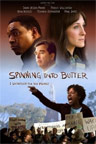
The movie Spinning into Butter (USA, 2009) is one of the rare works to pick up racism as a topic for a feature film.
It's a powerful film about a series of racist incidents on a campus which shake the community out of their equal opportunity sleep. The film shows how difficult it is to address racism on both a personal and community level, but also that there are no easy solutions.
Aboriginal hip-hop rapper Caper wrote a song about racism and discrimination that he has experienced in Australian society throughout his life.
Racist place names changed
When settlers named places in Australia they sometimes used names we consider racist today. Most of these place names have quietly been changed to less offensive ones, however, some can still be found today and some Aboriginal people campaign against them.
E.S. 'N–g–er' Brown Stand
Stephen Hagan fought for almost 9 years for a rugby league stand's name to be changed. It read E.S. 'N–g–er' Brown Stand.
Stephen Hagan took his case to the Federal Court (where he lost) and finally to the United Nations, where the Council for the Elimination of Racial Discrimination (CERD) agreed that the sign should be taken down. [70]
His campaign came at an enormous cost for him and his family. Not only did he have to invest a lot of money, but he was also personally assaulted and threatened. In September 2008 however, the stand was torn down and the mayor promised not to name the new building with the same name. Hagan's wife Rhonda directed a film about her husband's fight called N–g–er Lovers.
Racist Victorian place names
For decades a mountain in north-east Victoria, called Mt N–g–erhead, fuelled a heated debate about its name. In December 2008 the landmark was renamed to Mt Jaithmathangs after one of the traditional languages of the area [71].
This renaming, however, is not without controversy with one of the Aboriginal groups involved claiming that part of the mountain belongs to their country and its new name was offensive.
Racist place names in Queensland
In Queensland's Alton Downs, near Rockhampton, people are debating if they should rename Black Gin Creek Road. White Australians used to call an Aboriginal woman a 'gin', often implying that they were used for sexual services by the white men. Another Black Gin Creek Road is near Bambaroo, 60kms north-west of Townsville, Queensland. N–g–er Creek near Wondecla, QLD, is yet another example.
The reason that people so ferociously advocate for keeping these racist beacons of Queensland's past has a lot to do with the fact that many non-Indigenous Australians do not know what it feels like to be called a 'gin' or a 'n–g–er' or a 'coon'.
Australia is littered with places waiting to be reviewed, if not renamed.
For example, Gins Leap in Boggabri, NSW—said to be where a young Aboriginal woman took her life. Or Coon Island in Lake Macquarie. Or Poisoned Waterhole Creek on the Sturt Highway near Narrandera. Massacre Island on the Murrumbidgee. The list goes on.
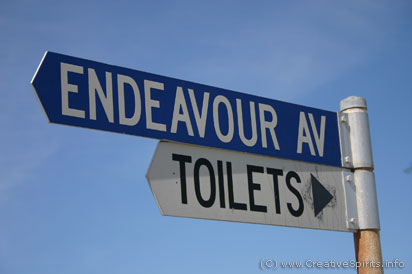
Renamed due to racism. The 'Endeavour Avenue' in Sydney's suburb La Perouse was originally called 'Aborigine Avenue' but later renamed after Captain Cook's ship "following agitation from non-Aboriginal residents" [72]. Its former name is much more appropriate since La Perouse once was an Aboriginal mission and today is home to many Aboriginal families.
Contemporary racism
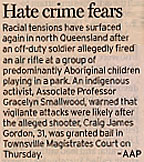
Not worth a big story. A solider fired shots into a group of Aboriginal children, but instead of headline news this is as small as a story can get [73].
A subscriber to an Australian newsletter made the following observations [74]:
"If you want to find out about Australia put a sticker supporting Aboriginal causes on your car. Young blokes are usually the main problem as far as abuse goes. The reconciliation stickers seemed to be OK, but anything stronger than that eg Treaty or Land Rights causes a hostile reaction. I have even been abused for having a sticker advertising radio station Triple A Murri Country on my car."
"There's an extremely strong undercurrent of racism in Australia, although, on the evidence, mainstream rather than undercurrent is probably more accurate."
"The fact that politicians , police etc are afraid to call it what it is, suggests that a majority of Australians do not class this behaviour as racist and will vote anyone out who calls it racism."
"If you want to be a person of influence in this country you steer well clear of issues like Australian racism." —which confirms the quotes from the beginning of the page.
Last Australia Day I had both the Australian flag and the Aboriginal flag on my car aerial, with the Aboriginal flag first—my aerial was snapped off.
"Every Indigenous Australian has a story of racism," observes Amy McQuire from the National Indigenous Times [8]. She argues that "most non-Indigenous Australians have a story in which racist thoughts were uttered or acts occurred."
Racist experiences
Here are some examples how racism permeates everyday life, from ordinary people, to police, to federal ministers. Sadly, I could quote many more.
"Don't worry love, these things happen."
During a rugby league game a fan racially abused Aboriginal players and supporters, calling them 'monkeys' and 'blacks'.
When an Aboriginal witness asked for the manager she was told "Don't worry about it, it's football, these things happen."
However, in this instance the fan was tracked down and banned for life. [75]
"I'm of a large build. Not fat and black."
An Aboriginal health worker was pulled over for a traffic offence. In internal police documents which were used to prepare the court brief the worker was described as 'fat and black' [76], words which were also included in drop-down menus of internal document templates [77].
Queensland Police commissioner Bob Atkinson later apologised to the victim.
Showcasing Aboriginal people
In July 2006 as part of an employment scheme then Aboriginal Affairs minister, Mal Brough, proposed 'showcasing' Aboriginal people for tourists in five-star hotels by having them work 'front of house' on reception [78].
Racism at 17
Tjimarri is a 17-year-old and tells his experience with racism [79].
"As a young Aboriginal sports player, I have experienced racism. When I first joined a club about six years ago with my two cousins, we were sitting down watching because we were too shy to participate first.
"A parent member called the police complaining that we were 'hanging around the club probably looking to go through people's bags'."
People... would attack my Aboriginality and they'd call me a black bitch. All my life I've been criticised because I'm Aboriginal.
— oan Winch, Nyoongar Elder and Professor at Curtin University [80]
Story:
"What, 'Abos' isn't racist?"
Ranu from Queensland contacted me [81] and sent me the following story which I offer here with permission.
"We have just recently moved to QLD much to my fear! I am of Papua New Guinea Australian descent and I have always been fearful of racism. This is something I have experienced regularly while coming here for school holidays.
"I also grew up in Adelaide in the 70's and spent every day at school dealing with awful racist taunts, then my parents moved us to Darwin where I was much less exposed to it.
"My daughter (12) had an incident at school today where a guy in her class said "My project is about Abos". She has never come across such blatant racial remarks like this and I guess didn't know how to deal with it so she walked up to the guy and she kicks him. He said to her "What was that for?" and her remarks back to him were "for being racist". He says "What, Abos isn't racist," so she says "Yeah. It is. Look it up looser!"" [...]
"On the weekend after visiting my husbands family [...] my father in law (who does indeed refer to his Ford Falcon as the 'foul coon') looked into our car where we had our seats arranged so the girls could comfortably sit with their legs out stretched and commented "What's this!? Blacks in the back?!" and so began 3 days of me trying to express (not very well) to my husband why I find this all so offensive.
"As an adult I have found it really difficult to deal with racism as I find it always raises for me again those feelings of hurt, insecurity and aloneness that I felt as a child trying to deal with it as the lone 'coloured' kid in my primary school."
"I don't like n–g–ers"
This is a true story conveyed to me by the mother of the Papua New Guinean girl.
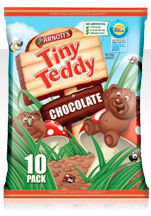
While at school a young Papua New Guinean girl was sitting with her friends—a lovely group of middle-class anglo Australian girls. She had a packet of honey-flavoured Tiny Teddies and one of her friends had a bag of chocolate-flavoured Tiny Teddies.
Tiny Teddies are cookies.
When her friend saw what the Papua New Guinean girl had she said "Oh! Can I swap with you I don't like n–g–ers," at which the Papua New Guinean girl snapped "What! What did you say!?". Her friend repeated, "Can I swap with you I don't like n–g–ers."
The Papua New Guinean girl exploded. "Hey! You can't say that! I have black people in my family, and you can't say that!".
Her friend began backpeddling and said "No, I didn't mean it like that, it's just that I don't like these biscuits." Still angry, the Papua New Guinean girl said "Well say that then! You can't say that word it's offensive. I have black people in my family how dare you say that!"
The other girls in the group also spoke up and said "Yeah, you shouldn't say that it's not right!"
"They pay good money to get my skin colour"
Another true story as told to me first-hand:
"I was standing in a post office in what I like to now refer to as country red neck Queensland. The sales assistant has a chat with a young female customer in front of me.
I hear her saying '...did she like her spray tan?' and the girl goes 'Yeah, but her boyfriend said he didn't want to marry a coon.' They both laugh, and as she leaves they realise I'm standing behind them.
I give them the death stare and they drop their eyes in shame as they should.
They pay good money to get my skin colour and they still insult us!"
Taxis refuse fare to Aboriginal actors
In May 2013, a group of prominent Aboriginal actors were repeatedly refused fare by taxi drivers in Melbourne when they tried to make their way back to work [82].
The group included eminent actors such as Tom E Lewis, Rabbit-Proof Fence star Natasha Wanganeen, Redfern Now actors Jada Alberts and Rarriwuy Hick, Chooky Dancer Djamangi Gaykamangu and Ten Canoes actor Frances Djulibing.
Four separate cabs booked to pick up the group refused the fare once they arrived and saw the passengers.
Only after the non-Aboriginal company manager hailed a taxi were the actors able to return to their hotel.
''They would just pull up, see us and drive off,'' Hick said. ''By the fourth one I just had it by then and kind of broke down and was in tears. We had to get someone to hail a taxi for us who was non-indigenous and we would hide around the corner and by the time she got the taxi we would bolt over, open the door and jump in.
[There are] many layers of racism that veil Australian society, and the prejudices and stereotypes… are the stitches on these veils.
— Gerry Georgatos, Human Rights Alliance, Perth [22]
Racism in the press
The press shapes how many people think about other ethnicities. Journalists have a responsibility when they write about Aboriginal culture. They are bound by the Racial Discrimination Act while the freedom of speech gives them a certain liberty.
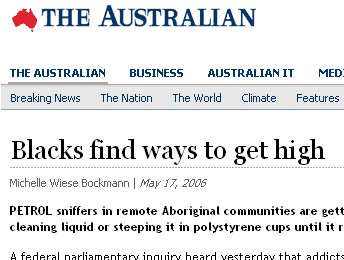
Racist headline in The Australian. Aboriginal people believe this newspaper does not support their interests and uses the term 'blacks' in a derogative manner. A lack of positive Aboriginal stories is prevalent throughout Australian newspapers.
'Black' in general is deemed racist. Which does not mean we cannot find it nowadays. Check out the newspaper article in the image which is taken from The Australian newspaper of May 17, 2006. Aboriginal people confirmed to me that this headline is offending. I found this headline in an online search in less than three minutes. Searching The Sydney Morning Herald online did not turn up any similar headline.
Journalist found guilty of racial discrimination
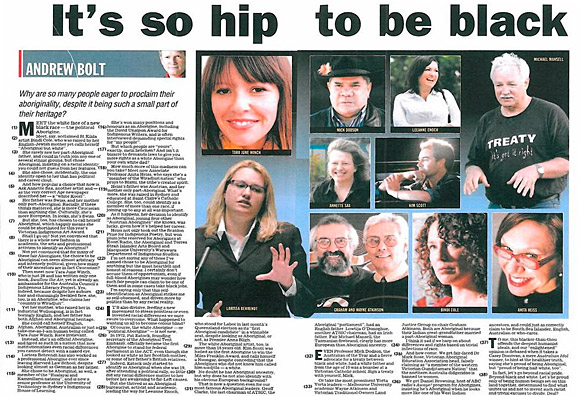
In 2011 journalist Andrew Bolt from the Herald Sun newspaper wrote two articles about Aboriginal identity. In questioning how some Aboriginal people "selected" their Aboriginality over other parts of their heritage, he addressed a common stereotype: Aboriginal people of mixed descent want to profit from benefits even though they are not "fully" Aboriginal.
One of the Aboriginal women Bolt targeted took him to court over his articles, alleging racial discrimination. In September 2011 the court confirmed that Bolt's articles had breached the Racial Discrimination Act [83].
Judge Bromberg ruled that he had "not found Mr Bolt and the Herald & Weekly Times to have contravened section 18C [of the Racial Discrimination Act], simply because the newspaper articles dealt with subject matter of that kind. I have found a contravention of the Racial Discrimination Act because of the manner in which that subject matter was dealt with." [83].
Judge Bromberg found that Bolt's articles "conveyed offensive messages about fair-skinned Aboriginal people, by saying that they were not genuinely Aboriginal and were pretending to be Aboriginal so they could access benefits that are available to Aboriginal people". "None of them 'chose' to be Aboriginal," the judge remarked.
"I am satisfied that fair-skinned Aboriginal people (or some of them) were reasonably likely, in all the circumstances, to have been offended, insulted, humiliated or intimidated by the imputations conveyed by the newspaper articles."
He further explained that "at the core of multiculturalism is the idea that people may identify with and express their racial or ethnic heritage free from pressure not to do so. People should be free to fully identify with their race without fear of public disdain or loss of esteem for so identifying. Disparagement directed at the legitimacy of the racial identification of a group of people is likely to be destructive of racial tolerance, just as disparagement directed at the real or imagined practices or traits of those people is also destructive of racial tolerance."
The articles, the judge found, "contained errors of fact, distortions of the truth and inflammatory and provocative language."
The articles could have an "intimidatory effect" on young fair-skinned Aboriginal people or those who do not have a firm view on their identity because "racially prejudiced views have been reinforced, encouraged or emboldened".
Discriminatory article. The judge did not condemn that Andrew Bolt had critically written about Aboriginal identity, but he found that Bolt had violated the Racial Discrimination Act by how he had written about the subject.
But Your Skin Is White
Why do we as people cry when they say you're not black your skin is white
Yes this day I hear again they tried, but it's time yes time to squash this lie
Is it done to cover up mistakes or just for fun yes it's a damn disgrace
For 200 odd years you've made this mistake at our expense
We've been pushed and shoved and totally displaced you pull down things
 that are sacred to our race, you dig up then place a barbed wire fence
It's a safety measure for you at our expense
And when we go for food they say these blacks they're not wanted
Here on my land but whose is it really is it really yours I say
You cannot recompense us for all the wrongs you've done
Or bring back a parent a daughter or a son
Yes it's just not right I hear you say these blacks are white
Just look at their face
Yes it's no longer right for it's free speech you say
We've done no wrong so why should you pay
It's always them white blacks that push the limit
It can never be you yes it's always them
Yes those white blacks you say 'cause there's money in it
They just want their pay
Yes I want to tell you a story although my skin may be white
Look at my heart it's from the dreamtime I come
Yes I am daughter a father a son
I am the mother of these ones
The trouble makers with the white face the ones that 200 years
Can never disgrace...
Another example of the extent of prejudice is the intolerance of Australians to foreign languages being kept and used by the new immigrants. Too often we hear white Australians talking amongst themselves that when people come to this country they should speak English and leave their own mother tongue back in the country from which they come.
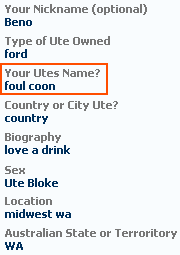
Racist term used in a profile of a car forum member. The man was 25 years old and lived in Western Australia where also the car race incident occurred.
"I didn't realise it would be so bad," a careless white man said after he had sparked an outrage in Western Australia's Kalgoorlie [86].
The man had participated in a car race and named his car 'Foul Coon' because "we have always called Falcon cars 'foul coons'". What he considered to be "just a saying" deeply angered and offended local Aboriginal people. To add insult to injury some other team members had painted themselves black and wore red headbands, traditionally worn by senior and respected initiated Aboriginal men.
'Foul Coon' is used colloquially in car forums around Australia. The forum profile shown here seems to confirm what the CEO of the Goldfields Land and Sea Council, Brian Wyatt, told newspapers: "They think that beer and naked girls behind the bar... are the way of life around here, and saying and doing whatever you like when you like."
Aboriginal people allege hotel racism
A group of Aboriginal people took the former owners of the Newcastle 'Sydney Junction Hotel' (NSW) to court for allegedly denying them access to the hotel because they're Aboriginal.
The issue was if the hotel had a 'no coons' policy and which person of the hotel's staff and security personnel was responsible for implementing this policy [87]. The pub operator and security firm were ordered to pay AUD 90,000 to the victims [88].
In a similar incident in March 2008 a group of Aboriginal women were asked to leave the Haven Backpackers in Alice Springs [89]. The group attended a lifesaving training and were told that they were "unsuitable" guests and were asked to leave shortly after checking in, because Japanese tourists were "afraid of Aboriginal people".
Once a person's a racist, it's difficult to change them.
— Tom Calma, Aboriginal and Torres Strait Islander Social Justice Commissioner [90]
Is this racism? Two views
When you read articles in any media be mindful that even they can express just the viewpoint of that particular publisher or writer.
Below is one such article and the personal viewpoint of an Aboriginal man about it. Compare the two and ask yourself:
West Australian police have been accused of racism for closing pubs in regional communities when a funeral is in town.
Liberal MP Barry Haase told federal parliament WA police were closing pubs during funerals because they were concerned about indigenous Australians drinking too much.
Mr Haase said this was racist towards Aborigines and unfair to pub owners.
He said the West Australian police force was either misguided or unable to maintain law and order in the communities concerned.
"In the Middle East we are trying to establish democracy, across the globe we are trying to stamp out racial practices and yet when there is an indigenous funeral to be held in my regional centres in Western Australia ... they impose their draconian attitudes," he said.
"It is not acceptable, we must not kowtow to the tiniest group of the community simply because of the tree huggers' attitude when it comes to the consumption of alcohol."
Democracy and freedom of trade needed to be returned to communities, Mr Haase said.
He said businesses had the right to keep their doors open and make a profit.
"We are finding that because authorities have no satisfactory explanation for the consumption of alcohol to excess in our communities they shut establishments down and simply send the guilty elsewhere to purchase their alcohol at inflated prices at the penalty of the innocent who are denied the opportunity to buy a legal substance," he said.
This is not racism
I'm with the cops and their precautionary measures on this one. I'm sick and tired of people bleating that anything they like (or dislike) can be put under the label of racism, sexism etc.
Coming from a small country town I know how these funeral wakes can get out of hand. Firstly, wakes are Wadjula [whitefella] culture, not blackfullas culture. Blackfullas have seemed to make them their own in recent years though, with many people celebrating somebody's life and death by getting wasted. I could never understand the mentality of this tradition.
The cops just mainly want people to stay safe, not start any trouble and then let everybody got their own way in safety afterwards.
Wakes can get very much out of control. One boy just got murdered after one in my town recently after they had just buried a girl who had been murdered by a man. Payback is a big part of our law and culture and wakes can make some people sitting targets.
Publicans only want their pubs open so they can make a killing at the bar. It sounds all very parasitic to me, but certainly not racist.
A Liberal MP of all people would put this put there. Haase shows just how ludicrous society has come to and how easy it is make comment, albeit reckless yet commonplace, than for leaders in our society to come out and actually show the way forward.
'Wadjula' is a Western Australian Aboriginal word for 'whitefella' or white people.
Antithesis: Australia is not racist
Some argue that "Australia is among the least racist countries of the multicultural developed world" [93]. They claim that Australia
has the highest rates of social mobility--many Australians were born overseas (Sydney has more than London or New York),
has the highest rate of mixed marriages in the world, and
has ethnic communities which are less likely to cluster into ghettos with all its follow-on problems.
Racism is used to explain what are in fact "multi-layered human motives". One such motif is the sense of "fairness for all Australians", sometimes brought forward by other migrants.
Actual racism, so the claim, is based on racism of the past, but today race is no longer a "significant disadvantage". Differences might just be due to class or socio-economic background. Racial prejudice becomes one of many factors.
When Aboriginal students underperform at school it is "more likely due to poor parenting, peer-group pressure and an inability to be responsible for their own behaviour." Rather than giving them the "discourse of the victim" these issues should be challenged.
"The more protection and measures there are to promote racial equality, the higher the risk of encouraging people to engage with each other not as individuals,... but in terms of our ethnicity," says Tanveer Ahmed, a psychiatrist [93].
Join thousands of Smart Owls!
This website is using cookies
This site uses cookies to personalise your experience.
If you continue using the site, you indicate that you are happy to receive cookies from this website.