Using the correct term for First Nations people shows respect, shows that you care, combats racism and might open doors. But which term is correct and how can you avoid mistakes?
People have used many terms for Australia's First Peoples. Early terms were utterly racist and remain offensive. Then 'Indigenous' was very popular before the politically more correct 'Aboriginal and Torres Strait Islander' replaced it.
But all these terms were coined by non-Indigenous people. Until now.
The new term that is emerging in Australia now is 'First Nations people(s)', has been chosen by First Nations people and is very apt for two main reasons:
'First' is a reference to the fact that First Nations peoples occupied Australia before anyone else. As it is often cited, they are the oldest culture on Earth.
'Nations' makes two important statements: First Peoples formed nations, not small groups. Each nation, just like any other nation on the planet, has its own culture, history and language. The plural, nations, alludes to the diversity of all nations within Australia. Coastal nations must be different to inland nations, but even two neighbouring nations can have very distinct cultures. Always remember this diversity.
Always capitalise both terms. It is an expression of respect.
Read on for more tips, especially when to use 'people' and when to use 'peoples'. [1]
Historical terms
Anti-racism campaign of the City of Sydney and the AIDS Council of New South Wales in May 2008 (detail). Note the use of the word 'Aboriginals', a term which is no longer appropriate. Click the image for a larger version.
Many historical terms are the legacy of invasion. It were non-Indigenous people who created them, and they still circulate in peoples' minds. Let's have a closer look.
"Aborigine"
'Aborigine' comes from the Latin words ab meaning from and origine meaning beginning or origin. It expresses that Aboriginal people have been there from the beginning of time.
'Aborigine' is a noun for an Aboriginal person (male or female).
The media, which is sometimes still using this term, has been called on to abandon it because its use has "negative effects on Aboriginal and Torres Strait Islander peoples' self-esteem and mental health". [2]
Many First Nations people consider the use of the term 'Aborigine' racist.
Aboriginal people are a diverse group of individuals and use of the term 'Aborigine' has negative connotations imposed during colonisation and can perpetuate prejudice and discrimination.
— Maria Tomasic, president Royal Australian and New Zealand College of Psychiatrists [2]
"Aboriginal"
Aboriginal, when used as an adjective, can describe 'Aboriginal people', 'Aboriginal houses' or an 'Aboriginal viewpoint'. Some sources continue to use it as a noun which I and many other people think is inappropriate.
'Aboriginal' should be written with a capital 'A' to show respect but also to differentiate Australian Aboriginal people from the aboriginal people all over the world. [3]
The Aboriginal Advisory Group of Community Legal Centres NSW recommends using 'Aboriginal people' or 'Aboriginal person' because these terms are "more positive and empowering". [2]
If you want to be exact you would need to talk about "Aboriginal and Torres Strait Islander people" because people from the Torres Strait have a different culture and identify strongly with their islands.
When you refer to an individual Aboriginal person it is better to refer to them with their language group, e.g. 'Budjalung woman Jane Smith'.
"I'm not adverse to being called 'Aboriginal'," admits Yugambeh man Shaun Davies, "it's merely that the term lumps us all together as one, takes away the individuality of each of our cultures. I enjoy the aspects of culture all us blackfella[s] share, but some whitefella[s] think... we all speak dialects of the same language, and share the same culture." [4]
Aboriginal is a non-Aboriginal word.
— John McBain, Secretary, Australian Country Farm and Community Garden Network [5]
The definition in a report uses 'Aboriginal' in an inclusive way and retains 'Indigenous' only where it is part of titles.
"Indigenous"
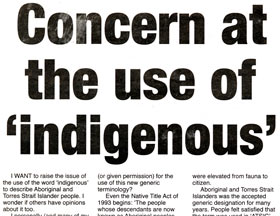
'Indigenous' is not accepted everywhere. Many Aboriginal Australians dislike the term because it was mainly used to describe plants and animals. [6]
'Indigenous' comes from the Latin word indigena meaning 'native to the land' or 'sprung from the land'.
Historically, 'indigenous' was used to describe animals and plants, and later First Nations peoples. If you open your wallet you can verify that even modern Australian coins show flowers, animals and—a First Nations person's head.
'Indigenous' also generalises mainland and islander cultures into one, ignoring the many different cultures that exist.
The term is still commonly used to refer to First Nations peoples, often in exchange with, and to avoid repetition of, "Aboriginal" or "Aboriginal and Torres Strait Islander".
But many Aboriginal people dislike being referred to as Indigenous. One Aboriginal woman with extensive experience in the education sector says that "the preferred term is definitely not Indigenous. The term 'Indigenous' and using the acronym ATSI can be offensive." It is also a term the government imposed and used as a category. [7]
Avoid using this term.
I am not an Aboriginal, or indeed indigenous, I am ... [a] First Nation’s person. A sovereign person from this country.
Many older books and articles talk of "the natives" or "blacks" when they refer to First Nations people. Avoid any of these labels as many consider them racist.
It is also important who starts using a term. As a non-Aboriginal person, pay attention to how a First Nations person refers to themselves. They might be perfectly fine with a term others consider inappropriate as the following story illustrates.
Story:
"Why I prefer the term ‘Black’"
Celeste Liddle is an Arrernte woman from Central Australia. She explains why she likes to call herself a 'black' woman.
"When referring to myself, and particularly talking with someone who I assume won’t understand what I mean by ‘Arrernte’, I tend to use the term ‘Black’.
"Why? Because in this country the term ‘Black’ carries a lot of political weight. It is [a] word that has power and a term that we’ve reclaimed. After years of removal policies and stolen generations based on the tone of one’s skin and their alleged blood quanta, to state that you are ‘Black’ regardless is defiant.
"It proclaims resilience in the face of harsh assimilation policies proudly." [9]
Fact
In July 2020, after the death of African-American George Floyd and the worldwide Black Lives Matter protests that followed, The New York Times decided to capitalise 'Black' when referring to peoples and cultures of African origin.
It seems like such a minor change, black versus Black. But for many people the capitalization of that one letter is the difference between a color and a culture.
As outlined at the beginning, First Nations is a term gaining more and more acceptance and use as First Nations people coined it, it alludes to who inhabited Australia from the beginning and it expresses the diversity of nations.
But getting it right can be tricky. Be aware of subtle variations and when to use them:
First Nations peoples: Use the plural ('peoples') when you refer to the many groups (nations) of First Nations people, each with their own language, cultural practices and beliefs. In other words, you want to emphasise diversity. Examples:
"At the time of European invasion, there were approximately 600,000 First Nations peoples."
"This is important to the Ngunnawal, Ngambri and Ngarigo peoples of the wider Canberra area."
First Nations people: Use the singular ('people') when you refer to more than one person. In this case you emphasise individuals. Examples:
"At the time of European invasion, there were between 300,000 and 1 million First Nations people living in Australia."
"I acknowledge the Gadigal people of the Eora Nation."
"We work with First Nations people within our school community."
First People(s): Some prefer this term over 'First Nations', and it still a preferable term over others because First Nations people have chosen it. However, in my mind it does not express diversity as well as 'First Nations'. One could assume there was one uniform First Peoples nation in Australia, similar to New Zealand.
You can combine 'First Nations' with other plurals, for example:
First Nations histories
First Nations cultures
First Nations languages
First Nations perspectives
etc.
All of the above clearly express that there are many different instances of each. This is important as it works towards a better understanding of diversity which, in the past, was not recognised enough (and often not at all).
Some sources suggest you can also use 'First Nations Australians', but quite a few First Nations people reject to be 'Australian' as that is a post-invasion term forced on them and they never agreed to either the term or the invasion. See further down this page for more details.
Be even better
Prior to colonisation First Nations people identified each other by their language group. They would say "I'm a Dharawal man!" or "I'm an Wiradjuri woman." Some country names around the greater Sydney area include Gundungurra (near Goulburn, south-west of Sydney), Dharawal (Woolongong), Eora (Sydney; although this name is disputed), and many more.
Others might prefer to use a name that refers to the area within Australia where they live. For example, Koori is used by people living in New South Wales and Victoria (the latter sometimes using 'Koorie'), while Murri is used for Queensland and far northern NSW.
The more specific you are, the better. If you can, ask the people you are writing or talking about for the term they are most comfortable with.
Here is what Yalmay Yunupiŋu, wife of Yothu Yindi band member Dr. M Yunupiŋu, said about her late husband:
"The name Yunupingu means a Rock, the rock Yunupingu stands in the middle of the ocean. The rock was his strength, 'A rock that stands against time.' His formal identity is Maralitja, Dhukulul, Ngunbungunbu, Barrupa, Rarrkararrka. These are his very important names identifying who he was and where he comes from." [11]
Questions
Which role had Dr M Yunupiŋu in Yothu Yindi?
Why am I not using his full first name? What is it, and what does it stand for?
Find out what the names of his "formal identity" stand for.
Compare how this man must have felt about his name to how you feel about yours.
First Nations people discussing an appropriate name
Every now and then First Nations people discuss which name is appropriate when people refer to them.
Here are a few quotes discussing the word "Indigenous": [12][13][14]
"I hate the bloody word ['Indigenous']. United we stand."
"Let's get rid of the 'I' word... I am what I am—I am Aborigine."
"Using Indigenous is to me inclusive of our Torres Strait Islanders who are also part of our country but do not always refer to themselves as Aboriginal."
"I think there is enough division in our communities now without anyone being more divisive about words... Let's be inclusive, not exclusive."
"I am Bundjalung, not Indigenous, I am an Aboriginal man."
"In my lifetime, I have heard too many people use the term Aboriginal to attack us. It's a word that cuts deep because it has been used with such hatred."
"The word Aboriginal does put us in the same category as plants and animals etc because basically the words Aboriginal and Indigenous mean the same."
"I am Koori... Don't we have more important things to worry about?"
Let's have one definition to suit us all. That is, the word 'Aboriginal', for we were all born of an Aboriginal culture. We live an Aboriginal culture and we will die an Aboriginal cultural person… Let us be united with one clear voice and tell governments and newspaper editors to refer to us as Aboriginals.
— Les Ridgeway (snr), Aboriginal Family Historian and Worimi Nation Elder [15]
Avoid "toxic labels"
Unfortunately some First Nations people begin to identify with, and behave in accord with the 'toxic labels' Australian society defines for them. [16] It is easier to act as mainstream Australia perceives a First Nations person than to challenge that cliché and overcome a continued negativity attributed to the Aboriginal stereotype.
According to senior First Nations academics, even terms such as 'urban', 'traditional' or 'of Indigenous descent' are seen as racist when defining or categorising First Nations peoples. [16]
While some First Nations people have no problems with identifying themselves as Australian, others vehemently reject such an association.
First Nations feminist and unionist Celeste Liddle is one of them. She views the idea of being 'Australian' as an imposition since First Nations people never agreed to being governed by the invaders. This continuous imposition by governments is the reason she rejects terms like 'First Australians': "We historically predate any notion of 'Australia' by several millennia," she says. "Despite what my passport says, I am never just an 'Australian' and I find being labelled as such, reiterative of this forced assimilation." [17]
Lidia Thorpe, a Gunnai Gunditjmara woman and senator of the Greens party, shares a similar view. "My people have been oppressed in this country for over 240 years. For me to proudly say I’m Australian, I struggle with that. It is not me, it is not who I am." [18]
Real Australians are not Aboriginal people.
— Celeste Liddle, Aboriginal feminist and unionist [17]
Join thousands of Smart Owls!
This website is using cookies
This site uses cookies to personalise your experience.
If you continue using the site, you indicate that you are happy to receive cookies from this website.

.jpg)