Stolen Generations
Stolen Generations timeline
Explore the timeline of the Stolen Generations—from the Board for the Protection of Aborigines to the Prime Minister's apology and beyond.
Found 92 results for your search. Showing page 2 of 5.
1965
-
The Northern Territory’s Supreme Court rejects the application by Frank Ganngu and Elsie Darbuma for the return of their three children, who were taken from the leprosarium at the Oenpelli mission (about 220 kms east of Darwin) and fostered out.
1969
-
Aborigines Welfare Board in NSW is abolished. By 1969 all states have repealed the legislation allowing for the removal of Aboriginal children under the policy of ‘protection’. In the following years, Aboriginal and Islander Child Care Agencies (AICCAs) are set up to contest removal applications and provide alternatives to the removal of Indigenous children from their families.
1980
-
Link-Up (NSW) Aboriginal Corporation established. Followed by Link-Up (Qld) in 1988, Link-Up (Darwin) in 1989, Link-Up (Tas) in 1991, Link-Up (Vic) in 1992, Link-Up (SA) in 1999, Link-Up (Alice Springs) in 2000, and Link-Up (WA- seven sites) in 2001. Link-Up provides family tracing, reunion and support for forcibly removed children and their families (Stolen Generations).
1983
-
The Aboriginal Child Placement Principle, developed principally due to the efforts of Aboriginal and Islander Child Care Agencies (AICCAs) during the 1970s, is incorporated in NT welfare legislation to ensure that Indigenous children are placed with Indigenous families when adoption or fostering is necessary. This is followed in NSW (1987), Victoria (1989), South Australia (1993), Queensland and the ACT (1999), Tasmania (2000) and Western Australia (2006).
1994
-
Going Home Conference in Darwin. Over 600 people removed as children, from every state and territory, meet to share experiences and expose the history of the removal of Aboriginal children from their families and the effects of this policy on Aboriginal people. They discuss common goals of access to archives, compensation, rights to land and social justice.
1995
-
The National Inquiry into the Separation of Aboriginal and Torres Strait Islander Children from Their Families is established in response to efforts made by key Aboriginal agencies and communities. It examines the effects of separation, identify what should be done in response, find justification for any compensation and look at the laws of that time affecting child separation.
The inquiry holds hearings in all states between December 1995 and October 1996 and received 777 submissions, 69% of those from Indigenous people, 6% from churches and 1% from government.
1997
-
The state governments of Australia formally apologise to the Aboriginal people [1]:
- 27 May 1997: Western Australia (Richard Court, Premier; Geoff Gallop, Leader of the Opposition)
- 28 May 1997: South Australia (Dean Brown, Minister for Aboriginal Affairs)
- 3 June 1997: Queensland (K.R.Lingard, Minister for Families, Youth and Community Care)
- 17 June 1997: Australian Capital Territory (Kate Carnell, Chief Minister)
- 18 June 1997: New South Wales (Bob Carr, Premier)
- 13 August 1997: Tasmania (Tony Rundle, Premier)
- 17 September 1997: Victoria (Jeff Kennett, Premier)
- 24 October 2001: Northern Territory (Claire Martin, Premier)
On a national level, prime minister John Howard refuses to apologise to the Stolen Generations for another ten years. He is forced out of office in the federal election in 2007, never having apologised.
They can't give me back my mother, my lost childhood... but when Bob Carr gave his apology it was a removal of all my mother's guilt, the secret she bore alone... the apology set her free.
— Aunty Nancy de Vries, taken at 14 months [2] -
The 700-page report of the ‘Stolen Children’ National Inquiry ‘Bringing Them Home’, is tabled in federal parliament. The report concludes that the forcible removal of children was an act of genocide, contrary to United Nations Convention on Genocide, ratified by Australia in 1949. Australians are shocked by the report’s details.
-
Publication of the Report Into the Separation of Aboriginal and Torres Strait Islander Children from Their Families, more commonly known as the Bringing Them Home Report. An abbreviated version is called 'Bringing them Home - Community Guide'. The inquiry made 54 recommendations, e.g. reparations and an apology to Aboriginal peoples.
Key findings:
- 10 to 33% of the Aboriginal children were removed from their families between 1910 and 1970.
- The stolen Aboriginal children often suffered physical and sexual abuse and official bodies failed to protect them.
- Many Aboriginal children were never paid for the work they did ('Stolen Wages').
- Under international law, from approximately 1946 the policies of forcible removal amount to genocide.
- The removal of Indigenous children continues today.
However, there was no process established to monitor, evaluate or review each recommendation (which was the Report's 2nd recommendation).
I know of no Indigenous person who told their story to the inquiry who wanted non-Indigenous Australians to feel guilty—they just wanted people to know the truth.
— Mick Dodson [3]
1998
-
National Archives Australia - Bringing Them Home Indexing Project is launched. The project is focussed on the identification and preservation of Commonwealth records related to Indigenous people and communities.
-
Inaugural Sorry Day. The Bringing Them Home Report had suggested "to commemorate the history of forcible removals and its effects" on May 26 (recommendation #7a). Sorry Day offered the community the opportunity to be involved in activities to acknowledge the impact of the policies of forcible removal on Australia's Indigenous populations.
Sorry Day has been an annual event since.

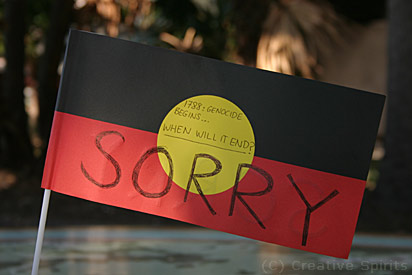
Sorry Day 2007. Someone had planted an Aboriginal flag on the ground expressing his sorrow for what had happened to Indigenous people. -
Aboriginal people across Australia hear with shock the comments of Aboriginal Affairs Minister Senator John Herron as he says stories of widespread removal of Aboriginal children from their families were exaggerated and that the removals that did occur were for lawful reasons "as occurs under child welfare policies today."
-
Australians for Native Title (ANT) launches the Sorry Books campaign, an opportunity for everyday Australians to give a "people’s apology" for past wrongs to Aboriginal people in lieu of the federal government's refusal to make a formal apology to the Stolen Generations. ANT circulated about 1,000 books over four months in libraries, museums, churches, shops, art galleries and schools.
The UNESCO added the collection of Sorry Books to its Memory of the World Register on 10 August 2004, in recognition of their historical and social significance.
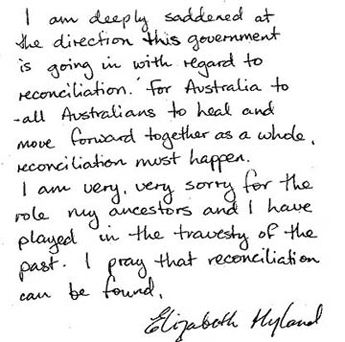
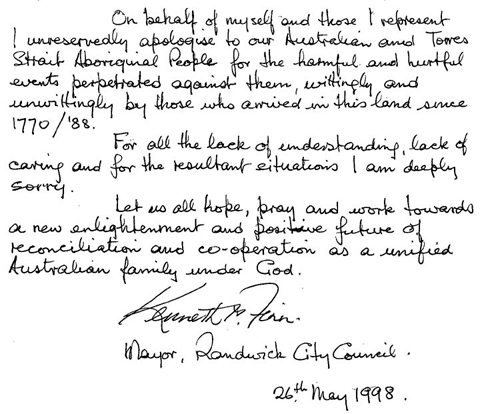
Sample Sorry Book entries. Children, celebrities, migrants and visitors alike signed Sorry Books. [4] -
One year after the Bringing Them Home report the first Sorry Day is marked by hundreds of activities around the country. The Australian federal government does not take part in ‘Sorry Day’, saying people who removed Aboriginal children thought they were doing the right thing and people now should not have to say sorry for what people did in the past. Over 1 million signatures in thousands of Sorry Books speak a different language.
-
HREOC releases the Social Justice Report 1998, which includes a summary of responses from the churches, and non-Indigenous community to the inquiry's recommendations plus an Implementation Progress Report.
1999
-
Federal parliament issues a statement of sincere regret over the forced removal of Aboriginal children from their families.
-
Federal Parliament issues a statement of deep and sincere regret over the forced removal of Aboriginal children from their families.
2000
-
Australia appears before the United Nations Committee on the Elimination of Racial Discrimination. The Committee criticises the Commonwealth Government's inadequate response to recommendations of the Bringing Them Home Report: "While noting the efforts by the State party to address the tragedies resulting from the previous policy of removing indigenous children from their families, the Committee remains concerned about the continuing effects of this policy. The Committee recommends that the State party intensify these efforts so that the victims themselves and their families will consider that they have been afforded a proper remedy."
-
Inquiry into the federal government's implementation of the recommendations made by the Human Rights and Equal Opportunity Commission in Bringing Them Home undertaken by the Senate Legal and Constitutional References Committee results in the Healing: A Legacy of Generations Report.
-
Australia appears before the United Nations Committee on the Elimination of Racial Discrimination. The committee criticises the government’s inadequate response to recommendations from the Bringing Them Home Report.
References
View article sources (0)
[15860] From Dispossession to Reconciliation, John Gardiner-Garden 1999
[15860b] 'Vale: Nancy de Vries 1932 - 2006', ANTaR newsletter 6/2006 p.5
[15857] 'Hands across the nation', Professor Mick Dodson, The Age, 13/2/2008, p.21
[15863] Australian Institute Of Aboriginal And Torres Strait Islander Studies, Sorry Books Exhibition, www.aiatsis.gov.au/collections/exhibitions/sorrybooks/introduction.html
