An Aboriginal woman is 45 times more likely to experience domestic violence than a white woman. Violence patterns are passed on from parents to their children.
Times higher: The likelihood an Aboriginal youth is a victim of proven abuse or neglect, compared to their white peer. [1]
4
Times higher: The probability of an Aboriginal child under 5 years to die as a result of assaults, compared to their white peer. [2]
1.8
Times higher: The likelihood that an Aboriginal baby is neglected or abused, compared to a non-Aboriginal baby. [3]
40%
Percentage Indigenous children make up of all hospital admissions in the age group 0 to 4 who are admitted for assault. [3]
1,500
Number of people admitted to Alice Springs hospital between 1998 and 2005 with stab wounds. In 2007 Alice Springs was said to have the highest number of stabbings in the world. [4] Most stab wounds were in the thigh due to cultural practices.
$13.6b
Estimated cost of all domestic violence against women and their children to the Australian economy in 2008-9. [5]
53%
Percentage of criminal cases where the offender was known to the victim. Percentage of these cases where the offender was the spouse: 69%. [6]
4.8%
Percentage of Aboriginal children aged to 17 who were under care and protection orders in 2010. Same figure for non-Aboriginal children: 0.5%. [7]
5%
Percentage of women experiencing violence from a current partner and reporting the last incident to police. [8]
45
Times higher: The probability of an Aboriginal women living in rural and remote areas to experience domestic violence, compared to their white peers. [9]
35
Times higher: The likelihood that an Aboriginal women is hospitalised due to family violence, compared to a non-Aboriginal woman. [10] Other sources report a figure of 23 times. [11]
11
Times higher: The probability that an Aboriginal woman is killed as a result of violent assault. [12] Same figure for Western Australia: 17.5 times. [13]
2.6
Average number of women per day seeking treatment for domestic violence related injuries in Alice Springs (between 2000 and 2006). [14]
93%
Percentage of surveyed Aboriginal respondents who believe domestic violence is a crime. 98% of non-Indigenous respondents believed so. [15]
20%
Percentage by which Aboriginal Australians are more likely to commit offences of violence than their non-Indigenous counterparts. [16]
80%
Percentage of jaw fractures due to alcohol in the Northern Territory. Aboriginal people in the NT have the second highest rate in the world. [17]
>90%
Percentage of Victorian Aboriginal children removed from their homes due to family violence. [12]
>25%
Percentage of Aboriginal mothers who died in Western Australia between 1983 and 2010 as victims of homicide. [13]
We used to hide in the cupboard at night; so that it wouldn't be our turn.
The Australian government's Department of Social Services offers the following definitions: [19]
Domestic violence refers to acts of violence (physical, sexual, emotional and psychological) that occur between people who have, or have had, an intimate relationship. It tends to involve an ongoing pattern of behaviour aimed at controlling a partner through fear.
Family violence is the most widely-used term to identify the experiences of Aboriginal people because it includes the broad range of marital and kinship relationships in which violence may occur, rather than just intimate relationships. It involves the same sorts of behaviours as domestic violence.
In order to cover both definitions, commentators often use the expression “domestic and family violence” in Australia.
Domestic violence can also include social, spiritual, cultural and economical abuse, and one-on-one fighting, abuse of Aboriginal community workers and self-harm, injury or suicide.
But 25% of surveyed Australians did not believe that controlling a partner by denying them money was a form of domestic violence. 15% did not agree that controlling the social life of a partner by preventing them from seeing friends or family constitutes domestic violence. [15]
Domestic violence came with invasion
Many Aboriginal sources claim that the causes of domestic and family violence neither stem from, nor are part of Aboriginal culture. [12][20] It was the attempted destruction of Aboriginal cultures after invasion, and the ongoing disadvantage, dispossession of land, forced removal of children, structural racism, economic disadvantage, intergenerational trauma and deep-seated distrust of authorities which led to family violence proliferating in Aboriginal communities.
Sometimes my emotion gets the better of me, too – more times than not it comes out of frustration and anger, but that’s from my pain.
— Meyne Wyatt, Wongutha/Yamatji man and actor [21]
It is a myth that domestic violence is 'the Aboriginal way'. Marcia Langton AM, professor of Indigenous Studies at the University of Melbourne, questions whether Aboriginal society would have survived with such high rates of violence against women. "This is a sick situation. This is an unacceptable situation. It is severely perverted," she says. [22]
"Domestic and family violence in urban Aboriginal communities is happening," says Dixie Link-Gordon, a reader of the Aboriginal newspaper, Koori Mail. [23] "Community violence is running amok. It's a sad situation when others in our community make the choice to follow, if not participate, in these violent confrontations... There is really not one Aboriginal person who can say that community, domestic and family violence has not affected their mob or themselves on some level—including me."
In 2018-19, 16% of Aboriginal people over 15 years old had experienced, or were threatened with, physical harm at least once in the last 12 months. [24]
In the past governments, politicians and the media have all shied away from talking about and reporting on domestic violence. "In many respects our voices have been dismissed or silenced," says Dr Jackie Huggins, a supporter of a women's health group and co-convenor of the National Congress of Australia's First Peoples. [20] Thankfully that attitude is slowly changing.
Governments can assist but only local people can stop the violence.
— John Cobb, Acting Federal Indigenous Affairs Minister [25]
Award-winning anti-violence video
Woolbubinya Wellbeing Centre (Doomadgee, NT) produced Jane and Tom's Story, a video that won Best Film in the 'Our Way' category of the 2015 National Remote Indigenous Media Festival.
The story is about two characters and the challenges they experience relating to domestic violence and alcohol abuse.
Story:
From being banned to winning
Cherbourg's A-Grade rugby league side the Hornets were banned in 2002 from the Burnett Premier League in south-east Queensland because of fighting.
In April 2010 they set up a strict behaviour code and agreed not to be seen drunk or fighting in public, and they took part in protests against domestic violence.
Their commitment paid off as the team went on to win the premiership in 2010, and there has also been a notable improvement in the town's well-being. [26]
Causes of domestic violence
Court circles, police ranks and politicians fear an "epidemic" of domestic violence. [14] Participants of support programs talk about family violence as being the top of a "volcano" with a host of "explosive factors" under its lid. [20]
But what are the root causes of domestic violence or any other violent behaviour? One thing is certain: There is no single cause of violence in Aboriginal communities. [27][9][16][12][20]
Oppression. When Aboriginal men were dispossessed by the white invaders they lost their moral authority over their families. [28] After their wives were taken, white men abandoned them and their mixed-race children, leaving Aboriginal men to rear the family. No surprise they would feel anger and rage. Oppression turns people into oppressors.
European invasion and dispossession. European invasion plays a crucial role for marginalisation and dispossession. "After 200 years of abuse, physical and mental, we should not be surprised to find towering rates of domestic violence," says writer Germaine Greer. [28]
Childhood experience of violence and abuse. Aboriginal kids who were forcibly removed from their parents and put into missions were physically and psychologically abused. Their suffering was a seed of violence. "Children taken from their parents and treated cruelly in institutions will learn cruelty. Children who are bashed by their parents will bash their own children," says Germaine Greer. [28]
Abusive styles of conflict resolution. Aged ten, Bill Simon was taken away from his parents and witnessed violence in an Aboriginal mission first hand. Boys were beaten with cane sticks and put into solitary confinement. "Words of comfort for the bleeding boy behind the door were usually not much comfort," he recalls. "Time spent in that room was always associated with pain and loneliness and nothing anyone said could help. A few of the boys were often very angry and sometimes violent when they were locked up in there." [29] Unable to express their anger these boys suppressed their violence for many years only for it to come back eventually.
Violent family environment. When children witness their parents fighting, moving around and eventually breaking up, sometimes the only way they can express their sadness is through anger and violence.
Economic disadvantage, which includes unemployment, financial problems, poverty and economic exclusion. Living in a geographic location with poor access to services can lead to frustration and then violence.
Poor health. Many Aboriginal people have a lower level of health than other Australians, both physical and mental (e.g. depression, shame, anger). Intergenerational trauma can pass down through family lines, sometimes affecting three generations.
Lack of education.
Racism. An ongoing exposure to all forms of racism, including structural, systemic and indirect, causes stress and leads to violent responses.
Single-parent families and parenting at an early age.
Substance and drug abuse, for example alcohol or petrol sniffing. But attributing high levels of violence to just substance abuse can be an overly simplified view. [20]
Poor or inadequate housing. Many Aboriginal people live in overcrowded houses.
Social isolation and deprivation.
Loss of identity. People losing their sense of identity and self esteem can turn to violence to compensate. An imbalance and inequity within male and female roles can also lead to violence.
Sexual jealousy and pornography.
Lack of respect. within families, but also from younger generations towards Elders.
Loss of land and traditional culture. With strong bonds for their traditional homelands Aboriginal people have strong responses if they lose them. Some cultural practices mitigate against interpersonal violence.
Breakdown of community kinship systems and Aboriginal law.
Stolen Generations. Being a member of the Stolen Generations has a multitude of detrimental effects.
The true prevalence of Aboriginal family violence is unknown. What is known is that the violence is endemic and presents an extremely troubling picture of the situation in many Aboriginal communities.
— Conclusion of the Gordon Inquiry Report on family violence
I don't explode any more, but I still have that anger. I'm only glad I've had music. So many of my brothers and uncles have gotten lost in that anger.
— Archie Roach, Aboriginal singer and songwriter [30]
Domestic violence is a problem that tragically affects all communities... some are just better at hiding it than others.
The Ken Bone of 1990 is not a man you would recognise today, nor would you have wanted to. He admits this himself.
Back then, he was notorious in his southern Queensland community of Cherbourg for being a violent perpetrator, worse when fuelled by alcohol.
His only reprieve was the memory loss the morning after, when faced with others' recollections of his rage. He was simply too drunk to ever remember what he had done.
To say that he has since turned his life around is a great understatement. He has remained sober and remembers the day he vowed never to drink again.
"I was a woman basher, I was a violent man and drank all the time," he says.
"I remember the day I had my last drink, it was the 18th of March 1983 and I had been very violent with a female partner at the time. When I woke up and they told me what I had done, I didn't remember a thing but I knew I had done it. I knew what I was capable of and I felt sick."
Faced with this horrific realisation, he vowed to never touch another drink. And he hasn't. [32]
What is a 'safe house'?
Some Aboriginal communities have set up safe houses. They provide short-term accommodation to women and children who have experienced family violence or are escaping the threat of violence from husbands or partners. People stay between one night to one week.
The safe house at Yuendumu in the Northern Territory has a 3-metre fence and locked gate with intercom. [33] Women can gain access anytime by talking to known community members who have keys.
Rules and rights govern the women's stay. Alcohol is prohibited, and women are free to decide if they want to report incidents of domestic violence.
Effects of domestic violence
The consequences of family violence are devastating. People suffer from [9][22]
shock
guilt
shame
anxiety
chronic depression
chronic pain
death
dehydration
dissociative states
drug and alcohol dependence
eating disorders
emotional 'over-reactions' to stimuli
general emotional numbing
health problems
malnutrition
panic attacks
poor adherence to medical recommendations
poverty
repeated self-injury
self-neglect
sexual dysfunction: An Aboriginal man explained to police that he selected his rape victims by their Caucasian appearance--because his white father beat to death his mother when he was a child [34]
sleep disorders
somatisation disorders
strained family relationships, family or relationship break-up
an inability to adequately respond to the needs of their own children.
A lot of our kids, our young people, run around the streets, they're drug addicts, they're alcoholics... They're being neglected because of domestic violence.
— Carl Williams, Men's Program Coordinator, Wuchopperen Health Services, Cairns [35]
Why victims don't lay charges
It is extremely common for victims of domestic violence not to lay charges against their perpetrators. So common that some Aboriginal commentators speak of a"national crisis". [22]
Fear. Victims are afraid of retribution, further violence or their children being taken away. Fear is omnipresent and in many cases the perpetrator is the partner and accompanies their victims to the hospital, inflicting further harm to them when they return home. This prevents many victims pursuing their earlier complaints or even makes them renounce them. For these reasons alone, statistics about Aboriginal domestic violence are probably much more severe.
Lack of understanding. A lack of understanding of legal rights and options and how to access support when experiencing family violence.
Shame and stigma. Shame and stigmatisation occur because of the interconnectedness of Aboriginal society. [36] Its rules and obligations tend to "operate against disclosing victimisation". Some fear that disclosures could lead to more violence in the community.
"[I felt] sick with dread at the thought that my family and old friends might see how far down I had fallen," says one victim. [22] "In most cases, it is the fear of the Department of Community Services taking children, and the family members you have to deal with," says Charmaigne Weldon of why Aboriginal women could be reluctant to approach government agencies. [37] "If you put the men in with the police, family will ostracise you, and they might be the only means of support."
Mistrust. The legacy and impact of Australia’s colonial history has resulted in profound levels of mistrust of government, the legal system and mainstream service systems throughout Aboriginal communities, urban, rural or remote. Many rather turn to their families and communities than police. [36] "I still believe today... if I was a white woman, they would have got him straight away that day," says a victim who had to wait 4 years for police to arrest her abusive partner. [22]
Acceptance of violence, among other reasons because it is a situation that is familiar, whereas reporting the violence has unknown consequences. In some Aboriginal communities violence is so widespread that victims accept violence as inevitable and something to be tolerated and not disclosed.
Lack of services. Not many services are offering Aboriginal-specific victim support or are aware of cultural protocols. People also mistrust mainstream legal and support services to understand and respect the needs, autonomy and wishes of Aboriginal survivors.
Co-location of services. In the eyes of many Aboriginal women, co-locating family violence services with child protection services increases the changes of authorities taking away children. To protect their children, the women stay away. [38]
Lack of anonymity. Especially rural and remote communities don't offer the anonymity and confidentiality required for a complaint.
Keeping the family together. Women feel pressured not to leave a violent relationship because they want to keep the family intact and they fear that parental separation will threaten cultural connection (especially for children) and community cohesion.
If you charge someone it changes your life completely. There is fear that you need to overcome. Although you are the victim, you are always on alert to being ostracised by your own community not accepting the truth.
Sometimes, however, Aboriginal women simply don't want to have their violent partners arrested and jailed. They simply want the violence to stop. [39]
When asked why [she didn't want to press charges she] said that she loved her partner and didn't want him sent to jail. She just wanted the violence to stop.
Domestic violence is ultimately passed on to children who are born into and grow up in violent families.
Research suggests that the effects of domestic violence can create a heavy stress response even before a child is born, as changes in the mother's brain cause changes in the fetal brain, and later raised stress levels leading to behavioural problems in the child. [40]
Children are born into a state of extreme stress, and the impact can be measured up to the age of four. [40] Symptoms include learning difficulties, rage and anger responses.
The ripple effect of this type of violence is huge.
— Jayashri Kulkarni, director, Monash Alfred psychiatry research centre [40]
The first three years of a child's life have the greatest capacity to change the way the brain develops. The brains of children who have been traumatised by abuse or violence develop to be hypervigilant and focused on non-verbal cues, potentially related to threat. These children are in a persistent state of arousal and, therefore, experience persisting anxiety. [9]
Children growing up in a violent family believe that when they grow up this is a normal family environment.
"I read the files of children who have died in suspicious circumstances, following neglect and abuse," reveals Linda Burney, former NSW Community Services Minister and Wiradjuri woman. [41] "There is hardly a file where Mum or Dad wasn't a victim of abuse. This inter-generational passing on of violence and abuse is deeply worrying."
Aboriginal lawyer Josephine Cashman consequently sees the family as the place to stop the violence. "We've got to create safe families, to create great citizens. That is the best prevention for people ending up that slippery slope into prison," she says. [22]
Too often Indigenous men have been dispossessed and have suffered overwhelming losses of respect and human dignity resulting in a toxic legacy being handed from father to son.
Victims of domestic violence often suffer from multiple assaults which might threaten their lives. Here's a description of a case which lasted over three years; [43]
"[Over several months, her partner] stabbed Ms B. all over her body with a chisel and a fork. He hit her on the head with an iron bar and bashed her between the legs with a baseball bat. He burnt her feet with a branding iron, broke her jaw and created a deep gash across her leg with a broken plate. He held her captive while raping her."
Police and justice reactions to such cases are often slow. In this particular case evidence had been obtained by police two years after the violence started, but Ms B.'s partner wasn't convicted until five years after the torture began.
The victim also complained that she felt "more like a victim [because] she was repeatedly accused of fabricating, self-inflicting injuries and provoking [her partner]". One wonders what would have happened if the victim had been a white woman.
Story:
"I was covered in bruises"
This is an edited version of Najella Green's story of domestic violence. [44]
"This is my story of survival after suffering domestic violence in a former marriage. I was then a young 26-year-old.
My husband covered his drink problem very well for a while, then he started to come home drunk, abusive and I had many beltings. I also suffered verbal abuse.
When I got pregnant, I was bashed, as he did not want a child. When I was 3 weeks overdue with my son, he come home late and drunk--he suggested I'd had a man there. He bashed me and threw me against the end of the bed post.
I was due to be induced in hospital the next day and I was covered in bruises. I felt shame.
My doctor said: "You have been bashed, haven't you?" I said: "No, I fell." (My pride would not allow me to tell the truth.)
Anyway, my son was not breathing when he was born. However the doctors revived him. As for me, I had a lot of damage inside and could not stop bleeding. So at the age of 26 I had a hysterectomy [surgical removal of the uterus] - I was shattered.
A few times after being bashed, I asked the local police for help, but they said they did not interfere with domestic problems. Today I know things have changed.
I stayed with my husband because he promised there would be no more beltings.
When my son was 12 months old, my husband came home so drunk he could hardly walk. He bashed my face and head so badly, I was vomiting blood, which was pouring from nose injuries. He got frightened and drove [me] to the local bush hospital.
They would not take me in, as they said I had head injuries. So my husband put me in the car and drove speeding to a larger hospital.
I had five operations to rebuild my face. Bones and cartilage were smashed. I suffered anorexia and bulimia as well as low self-esteem. Police wanted to have me as a witness and say that I was hit by an object held by my husband, like a stick or something. I refused.
Reality came to me when my doctor said to me: "Leave now, walk out, or be carried out in a body bag."
I left and went to my parents, then admitted myself to hospital to try to beat anorexia and bulimia. For the next 20 years I had relapses and my weight ranged from 35kg to 45kg.
I still suffer panic attacks and the depression of loneliness. Today I am alive and alone but free.
My message to anyone today in a situation like mine is: Leave. There is help out there. I did not know of any help when I suffered. Never believe you are at fault."
How can we reduce domestic violence?
Because the causes of domestic violence in an Aboriginal families is specific to their context, responses must also be culturally specific in order to work.
Case studies in the Northern Territory have shown common elements that contribute towards successful outcomes. [33]
Let the community generate programs. The most successful programs are those developed by and for the Aboriginal community.
Engage the community. It is crucial to consult the community throughout the program's development, especially when the initiative comes from the government.
Empower the community. For communities to own family violence initiatives they need to be involved and supported, for example by men's groups which help build leadership and spread anti-violence messages.
Form partnerships. Many of the successful case studies had partnerships with government and non-government agencies.
Take a holistic approach. Initiatives need to address all aspects of violence, including what makes people be violent.
Connect to culture. Respect for traditional law reinforces anti-violence messages and builds positive community identity.
Involve men. Most responses to family violence are created by and for women, leaving some men feeling alienated. Men need to be part of the solution.
Empower women. Women's traditional culture and authority in the community needs to be promoted.
Build on community strengths. Programs have a greater chance of success when they build on the resources, networks or knowledge already present in communities.
Employ Aboriginal staff. The expertise of Aboriginal staff makes a crucial difference in successful services.
Trust is an important foundation, essential to overcome fears of reporting violence, fear of child removal or fear of racism. In that context it is important to help local police better understand family violence and how they need to treat witnesses and take statements. [20]
It is also vital to review the services available to victims. "The perpetrators of violence get more services than the victims do," says Aboriginal lawyer Josephine Cashman [22] who has analysed domestic violence in Aboriginal communities.
On an individual level, cognitive therapy and nurturing relationships help reverse the toxic stress response of the brain if traumatised children receive support at an early stage. [40]
I am a firm believer that the answer to Indigenous problems can be found in Indigenous communities.
— Tom Calma, former Aboriginal and Torres Strait Islander Social Justice Commissioner [45]
The Inteyerrkwe Statement against domestic violence
In 2008 Aboriginal men gathered to discuss how they could prevent domestic violence and why Aboriginal men were violent. They also tried to explain the background of male domestic violence. [46][47]
Over 95% of reported violent offences are committed by males. This is a male problem--it's up to men to take the lead in fixing it.
Patrick Dodson said that "there has been a process of undermining the role and status of Aboriginal men within our society since the early days of Australia's colonisation and continuing in recent commentary around the Northern Territory intervention."
Chairman of the Central Australian Aboriginal Congress John Liddle adds that "when you add to this the rapid changes in the role of males within that colonising society and the consequent dislocation of non-Aboriginal males and their struggle to define new self-images, it is no wonder that Aboriginal males may struggle to make sense of the contemporary world."
"And if those critical views of us as Aboriginal males are expressed with no effort to understand our cultural values, or the pressures caused by the colonial relationships and contemporary social transformations, then we become alienated from this society."
"This alienation is at the core of the struggle for male health and well-being, as it acts to debase men, stripping away their dignity and the meaning in their lives. We therefore need to confront these social relationships that shape our health."
Nearly 400 Aboriginal men took part in the gathering and issued the Inteyerrkwe Statement, an apology from men to women for violence and abuse.
Inteyerrkwe Statement
"We the Aboriginal males from Central Australia and our visitor brothers from around Australia gathered at Inteyerrkwe in July 2008 to develop strategies to ensure our future roles as grandfathers, fathers, uncles, nephews, brothers, grandsons, and sons in caring for our children in a safe family environment that will lead to a happier, longer life that reflects opportunities experienced by the wider community.
We acknowledge and say sorry for the hurt, pain and suffering caused by Aboriginal males to our wives, to our children, to our mothers, to our grandmothers, to our granddaughters, to our aunties, to our nieces and to our sisters.
We also acknowledge that we need the love and support of our Aboriginal women to help us move forward."
Note that the Inteyerrkwe Statement was carefully worded. It uses 'males' and not 'man' or 'men' so as to avoid confusion about 'men' as initiated males. [6]
Most Indigenous people are not violent, even though many live in communities where violence is endemic and are subjected to violence and systemic social disadvantage without becoming offenders themselves.
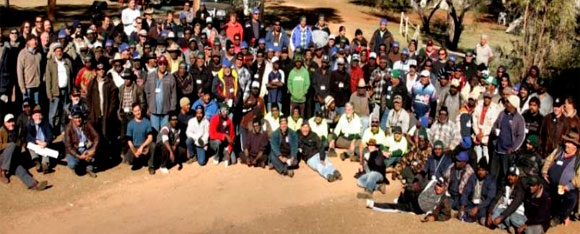
Members of the Ingkintja Congress of Male Health who met at Inteyerrkwe in 2008. Photo: Ingkintja
'Domestic Violence—it's not our game' initiative
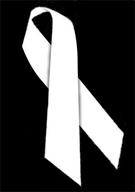
White Ribbon Day was first declared on 25 November 1999 by the United Nations General Assembly. It is a day where people of all walks reject domestic violence and symbolise this by wearing a white ribbon.
A successful initiative sees the Australian Football League (AFL) and the National Rugby League (NRL) teams throughout New South Wales and Victoria reduce domestic violence.
The 'Domestic Violence—it's not our game' initiative was conceived in March 2007 and aimed to tackle domestic violence in the remote Normanton community of 1,500 people in Queensland's far north-west. [49]
Northwest Queensland has the highest domestic violence statistics in the state and before the campaign began, Normanton had some of the highest rates in the region.
Members of the football teams agree to act as role models and to exclude from games any player involved in domestic violence. They wear the slogan on their clothes and equipment.
Domestic violence incidents dropped by 55%, breaches of domestic violence orders dropped by 64% and domestic violence is no longer accepted in the community.
Since Normanton the initiative has spread into more than 14 football clubs throughout Australia and New Zealand.
As much as men have contributed to violence against women and children, it is men and women working together that will be the source of healing.
Lana Walsh was killed by her de-facto partner on Anzac Day 1991 after suffering years of domestic violence and abuse.
In 2010 the Walsh family, with backing from the NSW government and White Ribbon Day, paid tribute to Lana by forming a memorial Aboriginal Rugby League side called Lana's Warriors to play at the Aboriginal Knockout.
"The stand we are taking is not just for my family, but for all families who experience domestic violence," says Luke Walsh, Lana's nephew.
"The boys will be playing to honour Lana, and remember her, but also to say to all the families at the Knockout that domestic violence is wrong. That it hurts women, it hurts children, it hurts families.". [51]
I want to be free – A song about family violence
If you want to be with me
Show me that you love me
Don't get wild, don't get jealous
Hey man be true to me
Don't destroy my life, my spirit
I'm not a slave, I'm not a rag doll
To be toyed with by you

 Chorus
 I want to be free
 Free as a bird
 But I'm still fighting for our freedom
 Us women need to be strong inside to fly
 We gotta stand up for our freedom

So be kind, treat me like a wife
Don't lock me in the room
I don't want to be suffocated
Don't want to be punched or bashed by you
And if I say I don't want to be with you
It's time for you to leave
It's time for you get out of my life
Don't abuse my body please

 Chorus
 I want to be free
 Free as a bird
 But I'm still fighting for our freedom
 Us women need to be strong inside to fly
 We gotta stand up for our freedom
This song was written by girls from Warburton High School and Primary School, Melbourne, Victoria and published in the Gordon Inquiry Report. [9]
Domestic and family violence helplines
National
If you are in an abusive situation or know someone who is, call 1800 RESPECT.
Men can also seek anonymous, confidential counselling through the Men’s Referral Service on 1300 766 491.
Nunga Miminis Shelter 8223 2200, after hours, call Crisis Care on 13 1611 (Support and emergency accommodation for Aboriginal women and children who are victims of domestic violence. Service available 9AM-5PM Monday-Friday).
Australian Capital Territory
Domestic Violence Crisis Service 02 6280 0900.
Victoria
Djirra (formerly the Aboriginal Family Violence Prevention and Legal Service Victoria) was established to provide assistance to victims of family violence and sexual assault and to work with families and communities affected by violence.
This site uses cookies to personalise your experience.
If you continue using the site, you indicate that you are happy to receive cookies from this website.